




TBL ARCHIVE – LED ZEPPELIN JANUARY 1975 SNAPSHOT/REMEMBERING MICK BONHAM /TWO INCREDIBLE NEW AUDIO CLIPS SURFACE/TBL ARCHIVE – JIMMY PAGE 2014 INTERVIEW /DL DIARY BLOG UPDATE
TBL LED ZEPPELIN JANUARY 1975 SNAPSHOT…

DATE: SUNDAY JANUARY 12 1975:
VENUE: BRUSSELS, BELGIUM
VORST NATIONAAL
Setlist: Rock And Roll/Sick Again/Over The Hills And Far Away/When The Levee Breaks/The Song Remains The Same/The Rain Song/Kashmir/The Wanton Song/No Quarter/Trampled Underfoot/In My Time Of Dying/Stairway To Heaven/Whole Lotta Love – Black Dog/Communication Breakdown.
Snapshot Notes: The second warm up date for their forthcoming US tour – the previous night they had played Rotterdam. Before the show Robert conducted an interview backstage with Bob Harris for broadcast the following Friday (January 17th) on BBC2’s Old Grey Whistle Test.
There were five previews aired from the forthcoming Physical Graffiti set – Sick Again, Kashmir, The Wanton Song (which would only be performed on a few of the opening US dates), Trampled Underfoot and In My Time Of Dying. They also included an arrangement of the never before played live When The Levee Breaks – this again did not last for too many performances on the US tour. With Page possibly dealing with a recently damaged finger (see more on this below), the set was less than two hours in length with little improvisation – Dazed And Confused and Moby Dick were both absent – rare omissions for the time. Robert Plant was also beginning to struggle with an oncoming cold. Presentation wise these two warm up warm-up dates were performed with a relatively simple stage set up for the final time.– the US tour will see John Bonham’s drums mounted on a rostrum and a major new light and laser show.
These dates were announced in the UK press at the end of 1974, but I somehow missed this info – – in fact I did not know the gigs had taken place until a week later such was the low key nature of the gigs – oh for the internet back then! If I had known, I would have made an effort to go for sure!
Snapshot Listen – how it sounded today:
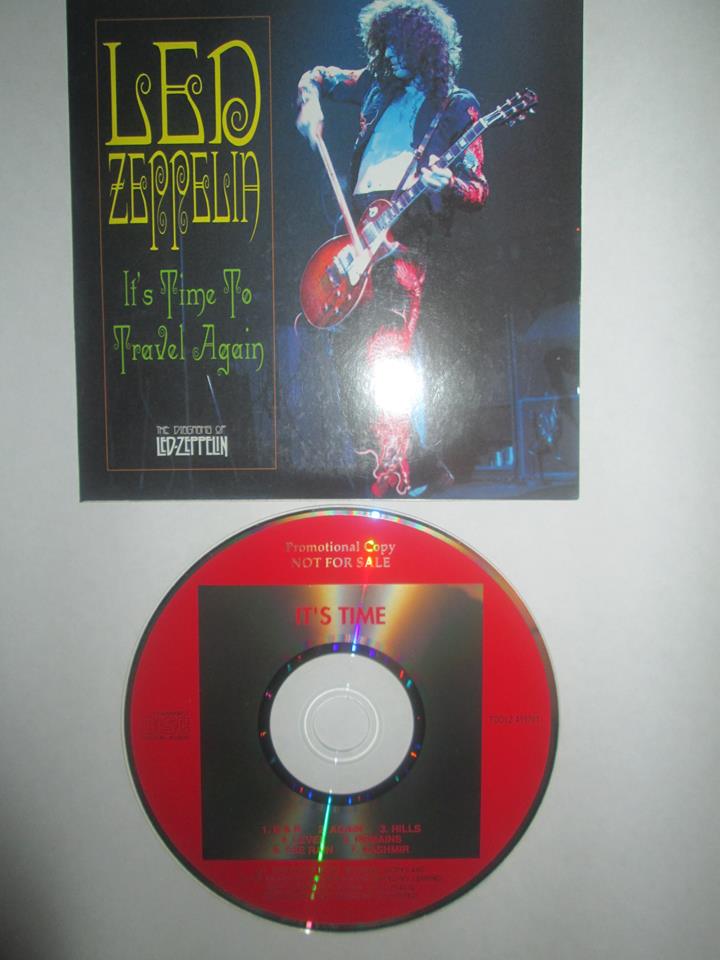
It’s Time To Travel Again (Diagrams of Led Zeppelin)
The January 12th Brussels show exists on a fair to good audience recording that I have on the Diagrams of Led Zeppelin CD It’s Time To Travel Again.
Here’s my overview of how it sounded today:
Given the physical frailties of Robert’s voice and (possibly!) Jimmy’s injured finger, once they get in their stride there are some fine performances. The set is a quant one with the notable omission of Dazed And Confused – along with the Rotterdam gig the night before, it was the first time this Zep I standard had not been played live in a Zep performance since their inception. There’s no Moby Dick either making for a much shorter performance than was the standard.
Sick Again kicks in after Rock And Roll and Robert plays it safe on the vocal histrionics. Jimmy is equally tentative on Over The Hills And Far Away with none of the expansive solo improvisation that will be a highlight on the US tour and Earls Court shows.
Their onstage rustiness is evident early on – amply demonstrated by Bonzo going into the intro of When The Levee Breaks when he should have been readying for Over The Hills – where’s that confounded written set list!
When The Levee is duly performed (‘’here’s one we always enjoyed and we’ve finally got around to playing’’). Bonzo is spot on but it’s a rather ponderous plodding arrangement – it will not last too many outings on the US tour. ‘’Jimmy Page steel guitar’’ proclaims Robert at the close.
The Song Remains The Same/The Rain Song are fairly perfunctory performances while the new Kashmir is initially a little hap-hazard. Robert loses the lyrics early on but they recover well for the final ‘’Let me take you there’’ sequence which prompts both Page and Plant to up their game.
‘’Another song of lust, a little habit I picked up after meeting Phil Carson (NB: Atlantic Records exec)– one of my idols’’ is Plant’s tongue in cheek intro into The Wanton Song – this works really well with Page now suitably animated in his playing – it’s a shame it was to fall off the setlist after a few performances in the US.
No Quarter is very much a 1973 arrangement with no extended grand piano section – which might be just as well as the crowd seem impatient and slow hand clap as the chorus comes back in. Before that, Jimmy gets into some very delicate and pleasing wah wah effects.
Two back to back Physical Graffiti previews follow: Trampled Underfoot is fast and furious and In My Time Of Dying is a valiant performance given the physical restraints. Both of these of course will come good with a few more performances
Finally…’’A song from not too long ago …what you might call a permanent favourite ‘ as Plant explains.
So come in Stairway To Heaven – now elevated to the main setlist closer. From the slightly extended strummed intro though to the crescendo ending, this performance strongly hints at the majesty this piece will attain ahead. It’s a great performance and worth the price of admission alone with Plant adlibbing away (note he still sings ‘’Dear lady’’ and ‘’Your Stairway’’ tonight – this will change to ‘’Dear people’ and ‘’Our Stairway’’ during the US tour). As for Jimmy, he delivers that long and winding jittering solo with sheer intent – a solo that will further develop and extend in the coming months and reach something of a zenith in Earls Court come May. It’s already very evident how much they have moved this piece on from the 1973 tour.
Encores: A brief Whole Lotta Love that segues into Black Dog and a strident Communication Breakdown with a chugging mid-section (‘’I don’t need…I don’t want’’) and gig number two of 1975 is over.
In the coming weeks in America , Plant’s voice will initially become weaker and Page’s finger injury will deem that How Many More Times temporarily replaces Dazed as the violin bow showcase. The stage setting will become more extravagant and the light and laser show ever striking. The audiences will become increasingly crazy, and a double album called Physical Graffiti will create a fervent rush at record stores across the land.
This night in Brussels is a quint and fascinating transitory performance – the health problems may be evident but inspired by their new material, this slightly tentative Led Zeppelin are very keen to make their mark in 1975.
And make their mark they will do as you will read in the next TBL Led Zep 1975 Snapshot…
To be continued…
Dave Lewis – January 14 2026.
Jimmy s Injured Finger:
It was well documented that Jimmy injured his finger – shutting it in a train door in early 1975 – it’s difficult to pin point the actual date it happened – I was under the impression it was just before the Rotterdam and Brussels dates but I could well be wrong. here are some thoughts on the topic from TBL contributor Andy Crofts
The 1975 finger thing, I couldn’t resist a quick word about that. It is frustrating, because it’s very hard to square all the reported facts.
You are right that it is simplest to assume that it happened pre-Brussels, but the Rolling Stone interview from March 75 is equally clear that it happened ‘just a week’ before the US tour started, and JP had only one rehearsal to work out how to play everything. Both Keith Shadwick and Mick Wall back this up in their books, although neither gives a proper reference, maddeningly.
The Brussels gig is weird, because they don’t play Dazed And Confused and How Many More Times -or Moby Dick for that matter, which I’d have thought ideal if the guitarist is unwell! But… JP plays very well in Brussels (this initially surprised me when I started listening), RP doesn’t make any mention of fingers onstage (which he does do on later US gigs), and the Bob Harris interview with him the same day doesn’t touch on it either. I also can’t help shake the feeling that they would just have cancelled those warm-ups had JP done his finger in immediately prior.
My take is that initially they never intended to play Dazed And Confused in 1975. They had other stuff in the set, like Levee and Wanton, and potentially others too; the setlist from the disputed Minneapolis rehearsal tape is an indicator here (I don’t believe this can be from 1973, but that’s a whole other argument!). So that’s why it’s not played in Brussels. They get to the US and realise they don’t like Levee, and need more material to fill the gap. This needs to be familiar to the audience, which won’t have heard the new stuff yet. The unrehearsed Dazed And Confused is considered a stretch too far, given the by-now broken finger, so they have a go at How many More Times for a few nights… equally unrehearsed, but it worked quite well when they did it impromptu in Southampton in 1973. Putting my guitarist’s hat on, I don’t see how a shortish Dazed And Confused is necessarily harder on the fingers than How Many More Times (something else that’s always bothered me about that part of the story), but the latter is certainly easier to pick up if you haven’t played it for a while.
All this squares the known and reported facts, and also makes sense of Jimmy’s other comment in Rolling Stone, that he wants Dazed And Confused back in the set ASAP… he preferred playing that to How Many More Times , which was probably a bit old-fashioned for him by 1975.
There’s another possibility of course, which is that the Brussels tape is incomplete, and other songs were played… it does seem very short. But I don’t think so. It’s maddening not to have anything from Rotterdam or indeed Minneapolis to compare it with.
Oops, I’ve written an essay. These nitpicking things are interesting in an ubergeek kind of way, and I think it’s fascinating how things which may not be quite right become accepted fact, just through repetition. I think Led Zeppelin simply started with one set list in 1975 and abandoned it in the face of their US audience. A shame. I’ve recently been reading about Cream’s experiences in the US, and they were the same; lots of parallels actually. Jimmy’s finger is ultimately a red herring, because – painful or otherwise – he plays very well throughout Jan 75.
Many Thanks Andy for those comments.
Remembering the late great Mick Bonham – RIP…
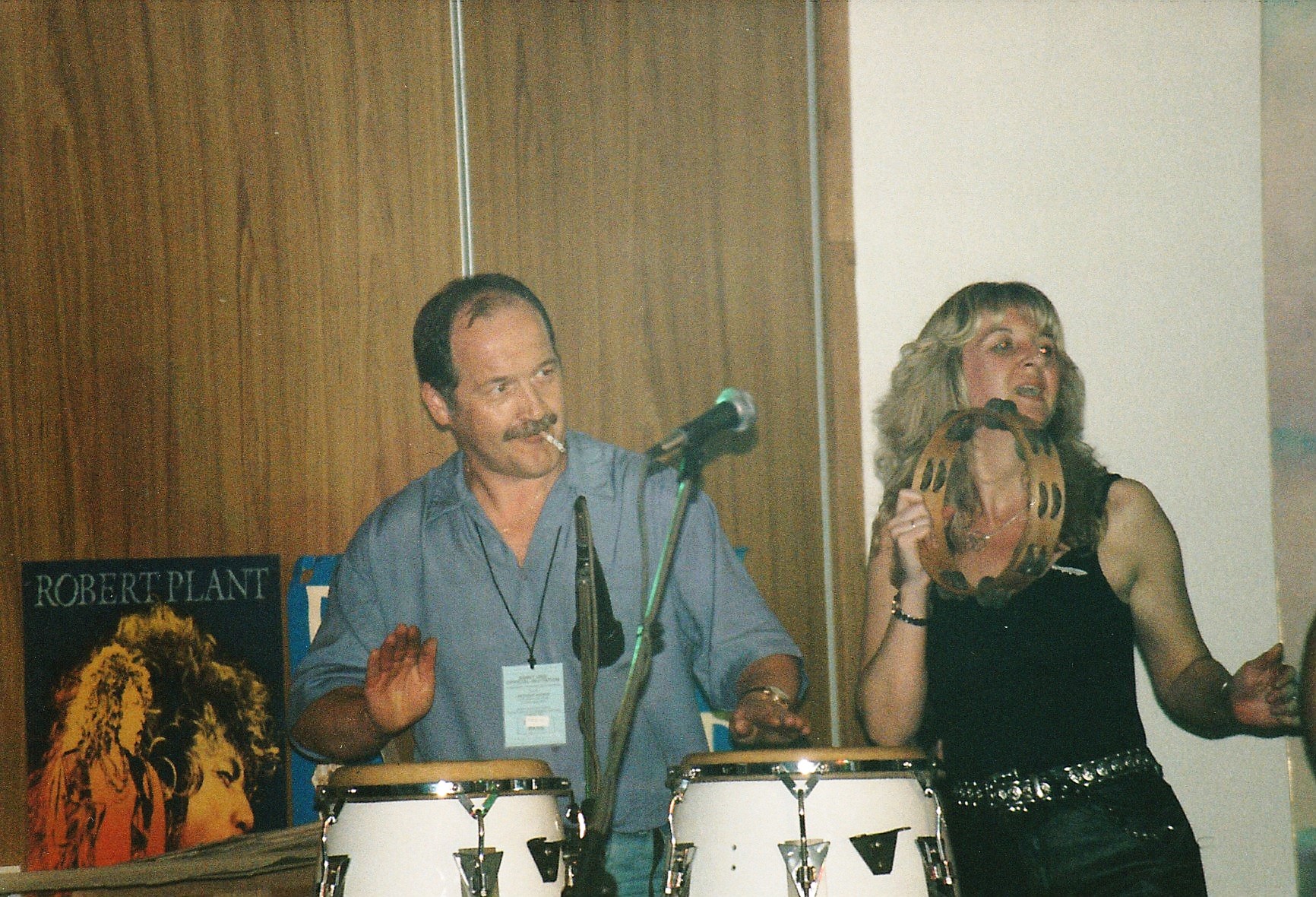
Remembering the late great Mick Bonham – 26 years gone …
January 14 marks the passing of Mick Bonham in 2000.
Back in early 1980, I first contacted Mick to request some of his amazing photos he had taken of Led Zeppelin at Knebworth to use in the then forthcoming TBL issue 4. He was more than generous in supplying a whole batch of previously unpublished shots. From then on he was always very supportive of my work and we often met at Zep related events.
His generosity and great spirit was certainly well in evidence when along with other members of the wonderful Bonham family, Mick attended the 1992 Led Zeppelin Celebration Days Convention the late much missed Andy Adams and I staged in London…here’s a great pi
——————————————————————————————————————————————————————
Two amazing finds:
A couple of fabulous audio clips have recently surfaced – here’s the info:
Led Zeppelin – NEW STEREO RECORDING SAMPLE – Live in Tokyo, Japan (Sept. 24th, 1971)
This is a bit special – hope there’s more to come…
Info via Led Zeppelin Boots:
I’m very excited to unveil this brand new, never before heard sample of a stereo recording of the band’s 2nd show in Tokyo during their 1971 tour of Japan. This small sample from Tarantura, which only encompasses Tangerine, is apparently from a reel to reel tape recorded by the promoter. Based on this sample, it sounds similar to the famous 9/29 Osaka “stage” source. This is huge news, as it confirms that at least one of the Tokyo gigs has a soundboard/multitrack out there somewhere
https://www.youtube.com/watch?v=DYLcp_K4y1g
…and there’s more…
Led Zeppelin – Since I’ve Been Loving You (1980 Rehearsal) – NEW TAPE
Another gem…
This via Led Zeppelin Boots
Here is a brand new, never before heard tape of Zeppelin performing Since I’ve Been Loving You while rehearsing for their 1980 Tour Over Europe. According to Tarantura, who released this, this is a “truly tape master” taken from the group’s rehearsals at the Victoria Theatre in London in preparation for the tour. Special thanks to Nicoxd for speed correcting and remastering this and to Nick for the thumbnail!
https://www.youtube.com/watch?v=bqeJfQSEbYk
————————————————————————————————————————
TBL ARCHIVE SPECIAL – JIMMY PAGE TBL INTERVIEW FROM OCTOBER 2014…
Right then – settle in for this, it’s a long one…
To further mark Jimmy Page’s 82ndt Birthday, here’s the extensive interview I conducted with Jimmy in October 2014.
Jimmy Page – The TBL Interview
In a landmark TBL interview, Jimmy Page talks to Dave Lewis about his post it note like reference works on the new companion discs, his desire to issue more experimental music, his passion for record collecting and his plans ahead – ‘’I really need to be playing….
A warm autumn Thursday afternoon. I am in the South Kensington area of London. Earlier that morning, on the recommendation from my good friend, Krys Jantzen, I’d popped into the John Varvatos store in Conduit Street just off Regent Street.
This is the high fashion outlet that recently opened with a major launch attended by Jimmy Page, Ringo Starr, Iggy Pop, etc in attendance. Jimmy has also done modelling for the Varvatos brand. A most impressive store it is, too – a sort of Hard Rock Café meets high fashion. It has a variety of rock’n’roll posters on display, books, limited edition guitars and the type of rock’n’roll clothing finery that the likes of Jimmy, etc can be seen in. In effect, it rocks… although at a high ticket price. It’s a great shop with a great atmosphere – a destination place for anyone visiting the area. Oh, and it sells vinyl, no bad thing in my book, of course. The photos of Zeppelin and Jimmy that adorn the walls are something of a scene setter for what I am in town for. I also take the playing of Dancing Days over the shop’s PA as a very good omen.
Back in Kensington and just past the Imperial Museum I notice a plaque commemorating the first Queen gig in July 1970. It strikes me there really should be a plaque in the capital to represent Led Zeppelin. In fact they could do worse than to place it around the corner at the Royal Albert Hall. For inside that hallowed building (the one, naturally, I have just paid homage to), on the night of January 9th 1970 Led Zeppelin came of age, with a remarkable and much chronicled performance – and a very fine way for the guitarist to have spent his 26th birthday.
Nearly 45 years on, just down the road from Albert’s place, the very same guitarist is waxing lyrical about the achievements of the very same group.
Jimmy Page has spent the day giving media interviews on the subject of the soon to be released second series of reissued and remastered Led Zeppelin albums – namely, Led Zeppelin IV and Houses Of The Holy, and his soon to be published photographic autobiography.
I am here representing the TBL magazine fulfilling one of those media slots.
So yes, at last, the opportunity has arisen to conduct a formal interview with Jimmy Page. A long held ambition of mine is about to fulfilled.
I’ve been reading interviews with Jimmy Page for nearly 45 years. Many memorable ones spring to mind – Richie Yorke’s encounters in 1970 and 1971, Chris Welch’s various Melody Maker chats, Nick Kent for the NME, the Knebworth ‘79 interview with Chris Salewicz in the same paper, and much later, Jimmy’s conversations with Mick Wall in Kerrang! and Classic Rock.
Jimmy has always been a good interviewee with a lot to say. Another interview that springs to mind is Cameron Crowe’s 1975 on tour rap with Jimmy for Rolling Stone. Back then, in the pre TBL days, holed up in my Zep bedroom den and devouring every interview as a passionate teenage Zep fan, the idea that I might one day fire the questions at Jimmy was pretty inconceivable.
So, on the one hand it does feel like I am about to have my own Almost Famous moment, in the way that Cameron Crowe is depicted in the film. On the other, it’s perfectly logical that a specialist Led Zeppelin magazine would seek to interview the band members.
John Paul Jones has been very forthcoming in that department, but it has not been so easy in the case of Robert Plant and Jimmy Page. Robert remains elusive but the quest for Jimmy is about to reach fruition.
So, how did this all come about? Well, the genesis of what will be mainly a talk about the latest Led Zep reissues, stretches back to a chat I had with Jimmy back in January 2013 at the Olympia Record Fair. He informed me then that he was working on the remastering of the Led Zeppelin catalogue. In fact, he was viewing a few of the studio bootlegs on some of the stalls and it was evident he was assessing what was out there as reference to his own archive findings.
It was then that I suggested an interview regarding all this for the TBL magazine would be of much interest to the readership. Jimmy agreed, and the plan he initially came up with was that we should perhaps get together for an interview after the first releases came out. He felt it ‘’would give us plenty of scope.’’
Later in the year, at the November Olympia Fair when I launched my Then As It Was, Led Zeppelin at Knebworth book, Jimmy was more than happy to talk on the progress of the project – revealing that each album would have a separate disc with alternate versions. “Each of the companion discs will be like looking through a portal and seeing where we were at during that particular stage’’, he told me, adding, very enthusiastically, ‘’The version of Since I’ve Been Loving You is so dramatic.”
Since then of course, many things have happened involving this project. I have been lucky enough to attend the two Olympic Studios playbacks and the Paris Olympia launch, with Jimmy undertaking a promotional campaign to enlighten the world’s media of this Zep reissue programme of quite massive proportions.
I duly kept out of the way in requesting an interview around the time of the first three reissues but it was always been at the back of my mind that, come the release of the next two (Led Zeppelin IV and Houses Of The Holy), I should strike. With a little help from one or two friends in high places and the Warners/Rhino/Outside guys, I’ve been added to the press pack line-up over two days of interviews taking place on October 1st and 2nd. I have been allocated a half hour slot at 3.30pm.
Now, I’ve been lucky enough to have had a fair few informal chats with Jimmy over the years – stretching back to 1980 and the Over Europe tour in Cologne, Frankfurt, Mannheim and Munich, in the Swan Song office in September later that year (a week before it all ended), in Swan Song to talk about the Coda album in the spring of 1982, backstage at Robert Plant’s Wembley Arena show in 1985, on tour with Robert in 1995 and 1998 and at various record fairs in recent years.
Up until now though, I have never conducted a one-on-one formal interview – and yup, I’m nervous. In fact very nervous . The sheer magnitude of what I am about to undertake is hitting home to me. Informal chats are one thing, a one on one interview conversation is something much more substantial. A quick pre interview pint is called for and I retire to the Queens Arms pub nearby, scene of more than one TBL pre-gig meet, notably that bizarre Teenage Cancer charity gig in early February 2002, when Jimmy and Robert appeared separately on the same bill.
I’ve diligently prepared a host of questions with the central theme of Led Zep IV and Houses Of The Holy, and a list of things extracted from an ongoing file I’ve had under the title ‘Questions I’d love to ask Jimmy Page’. Given the time restraints, I know the latter may have to wait for (hopefully) another time. No matter, finally I am here to interview him, and that represents a long time coming major coup for the TBL mag.
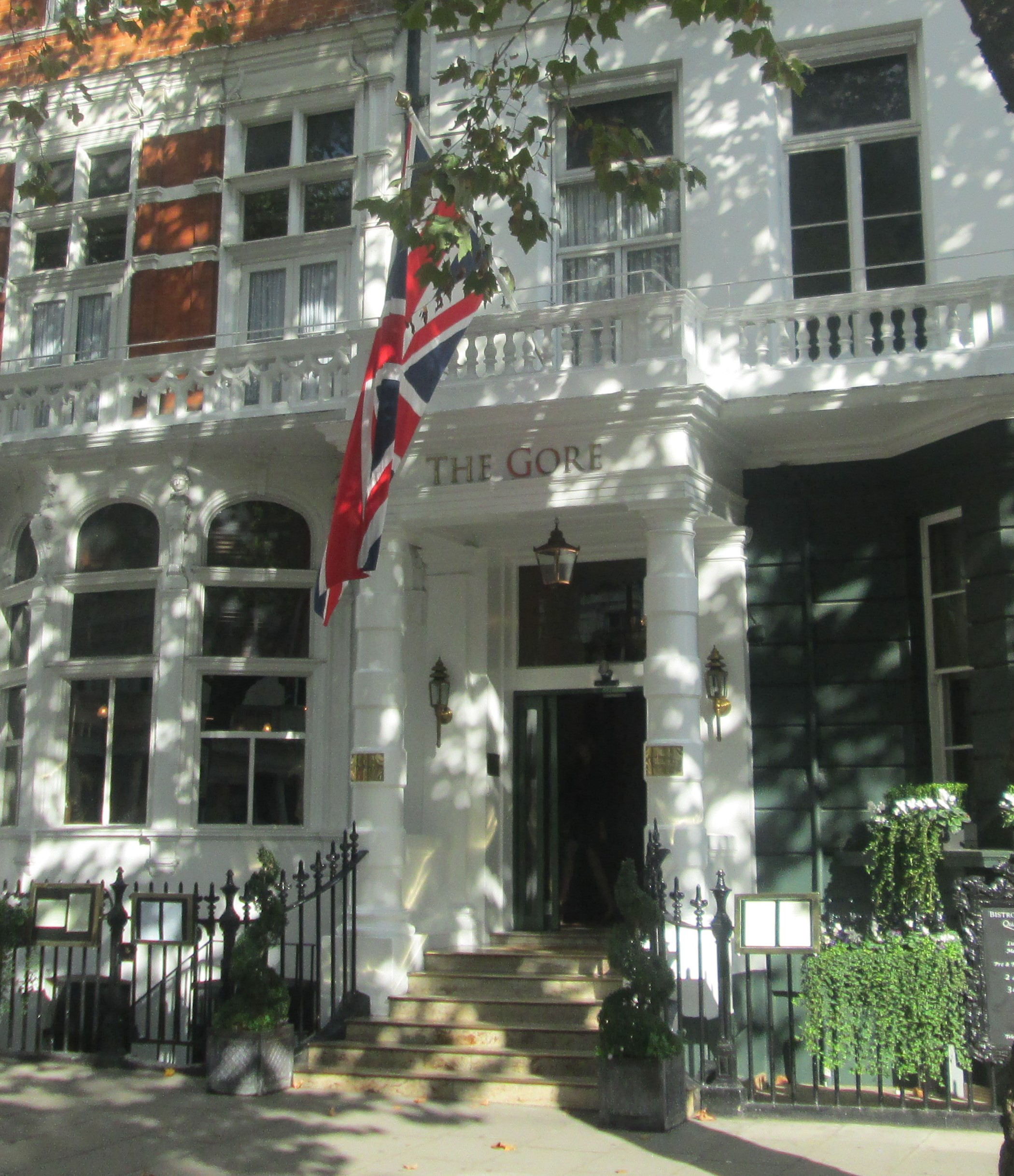
Unsurprisingly, things are running late as I arrive at the very plush Gore Hotel. BBC Online are filming an interview with Jimmy, and Michael Hann from the Guardian is yet to go in for his spot. There are already two other journalists in the queue behind me.
No time for nerves now. I am led into the extremely plush sitting room where Jimmy is conducting the interviews on his own. He greets me amiably, dressed in usual black attire and scarf (instant mental flashback at this point: Jimmy on stage at the Indianapolis rehearsal in 1975, in polka dot scarf).
Seated opposite each other, on extremely comfortable sofas, I set up my recording gear – digital dictaphone and back up cassette recorder( analogue rules!)
So I’m finally face to face with Jimmy Page one on one. And the opening words have to be…
So, shall we roll it, Jimmy?
DL: Just to backtrack to the first three reissues. La La was a real surprise. Why was it unfinished at the time?
JP: It was unfinished because there wasn’t any guide vocal that went on it from Robert. However, there are lots of overdubs on it, there’s acoustic guitar, lead guitar, all manner of stuff. And at the end there’s wah wah and echoplex bottleneck stuff. I mean there’s a lot that’s gone in to it but in a very short space of time. The recording process was done with ruthless efficiency. There wasn’t any hanging around and going down the pub and coming back, it was just full on commitment. So that was approached in exactly the same way. It was one of those things we put together in the studio. It had not had a previous run through or rehearsal, so you wouldn’t have expected Robert to know what to add. So, at the time, you might have heard, there was a guide vocal put on by John Paul Jones going ‘’la la la la.’’
DL: So that’s where the title comes from?
JP: Yeah, whatever the working title was, John Paul Jones did a ‘’la la’’ over the top, then it became La La, but it’s not something you could actually put out like that at the time.
DL: So there was a tape with him doing that guide vocal?
JP: After all the overdubs were on, he said, ‘’I’ve got a melody idea’’ and that was the ‘La La’ piece. It’s good though. It’s almost like one of those old ska things. It’s not a ska rhythm but it’s all that weaving around. I’m pleased we found it.
DL: Have there been things that you thought were in the tape archive that you could not locate?
JP: What do you mean, like Jennings Farm Blues? I knew that had been nicked. I tell you what I didn’t think I had. I didn’t think I had what was going to be the overture for The Song Remains The Same. I didn’t think I had that, I thought that had got nicked along with the Bombay sessions and all of that. I mean I did have stuff that got lifted right back in the day – the analogue tapes disappeared. But I did have that. It was for my own reference with all the guitars on it. It wasn’t a detailed mix but it’s got all the elements on and that’s what’s important really – I was shaping it all up.
DL: Am I right in saying that you used Fleetwood’s Mac’s Oh Well as a template for the vocal arrangement in Black Dog?
JP: Not really. We called it ‘call and response’. It was the way to approach the riff really.
DL: The version of Stairway To Heaven on the companion disc has a certain majesty about it. That’s from the Sunset Sound mix that was unused at the time?
JP: Yeah, and I’ve used the Misty Mountain Hop Sunset Sound version as well on the companion disc.
DL: So, why was the Sunset Sound mix of the album not used at the time?
JP: What happened with the Sunset Sound mix was this. Andy Johns and I went over to Sunset Sound in Los Angeles to mix the fourth album there, because of the facilities they had. They had natural echo chambers. I knew they had natural echo chambers at EMI, for example, but you couldn’t get in there. There was so much music that I liked that had come out of Sunset Sound, and it was a result of the limiters, the compression and the echo chambers – like the Byrds’ stuff, that was all done there.
I was keen and Andy was, too. There was also extra things that later came out on Physical Graffiti that we did at Headley at the time of recording the fourth album. There was Night Flight, Boogie With Stu, obviously, and Down By The Seaside – they all got mixed at Sunset, too. Going To California was mixed at Sunset but Battle Of Evermore wasn’t, that one didn’t go there for a mix but all the other things we did at the time we mixed there.
You might have heard this – and as a myth or rumour – but when we actually arrived, as were going through the airport, there’s an earthquake going on and when we get to the hotel room I was tired, but I felt the bed shaking, so I called Andy up and as I do, the bed’s juddering. I called him and said ‘’Are you ok?’’ and he said there’d been more tremors soon. We were due to go into the studio that night and, no word of a lie, I said to Andy there’s no way we are mixing Going To California until the end, because the lyrics mention an earthquake!
DL: The mountains and the canyons did start to tremble and shake – quite literally!
JP: Yeah! So anyway, so these mixes were done and the best way to describe it is that it was at the real audiophile end of the studio. It wasn’t limp, it was so powerful, the playbacks on their monitor system. We had accentuating highs and real deep lows on the low end of it.
So when we came back with these tapes to Olympic, we played them in the listening room through these little Tannoy speakers and the whole of the frequency range suddenly disappeared into the middle. And it was like ‘Oh god.’ And you have to understand, at the time there was talk of tapes getting damaged in transit and tapes getting wiped. It was like ‘Has something happened?’ as opposed to going ‘Wait a minute.’ The logical side of this is that the monitor system at Sunset was just totally different. It was a bit of a worry and a bit of a shock but I knew the mixes were good. It comes to the point where Levee Breaks – which is on the companion disc as the English mixed version – well, at the time it couldn’t replicate what’s going on with the depth, the density and the sort of menace that is there on the Sunset Sound mix. So the Sunset Sound mix got slipped on to the fourth album! I actually thought the Sunset mixes were pretty good, so we have got the opportunity now to hear three of those mixes, because we’ve got the original Levee and we’ve got Misty Mountain and Stairway on the new releases.
DL: It’s interesting to hear the acoustic outro to Over The Hills And Far Away on the companion disc version. How did you eventually come up with the reverb ending?
JP: I had the idea for it in my head, but the only way was to fade the track down and have the nakedness of the clavinets sort of thing going on. It’s just an experiment but I knew what I was trying to do. The mix you hear now, I hadn’t got to investigate it yet. So this version is a reference – it’s like a Post-it note. Then the whole thing changed – like the keyboard part, that isolated instrument, that was a really good way to end it. Like I said, what you’re hearing on the companion disc version, of over The Hills And Far Away – it’s like a Post-it note. That’s a good way to describe it.
DL: Did you consider using an alternative D’yer Mak’er mix, as that track is missing in the companion disc line up?
JP: The reason it’s not on there is there just wasn’t another mix that turned up. There wasn’t a rough mix from Stargroves. That’s all there was to it.
DL: The instrumental No Quarter really brings out the prowess of the group, musically. Did it feel as though you were breaking new ground at the time with that arrangement?
JP: Yes, for sure. John Paul Jones had the verse of No Quarter. The opening passage and the verse, that’s what he had with No Quarter. To move it from just having a verse to having that chorus and the riff that comes into the chorus, and then going back into the verse… well, it’s got this real movement to it and it’s absolutely classic. I knew it was so atmospheric and spooky. I knew something like that would work.
It was the same with Four Sticks as well. It’s abstract, it was going into the world of abstract, and that was really marvellous. That was what is what was so good about the band. There are these different character statements. They are called the songs but they are really character statements and they are all so different to each other. You can see how far we were pushing things.
DL: It’s so apparent how Houses Of The Holy is so different, in terms of the sound and general texture of sound to Led Zeppelin IV, isn’t it?
JP: Yes, that was always intentional – the fact that every album would be so different, and not just in as much as the actual content but the whole atmosphere.
DL: Looking ahead, what is the plan for the Coda companion disc which provides quite a lot of scope I would think?
JP: I can’t give much away at this point. Let’s say that if you think of what the original concept of Coda was in the first place, then I’m going to extend that.
DL: Are there any plans to release further Led Zeppelin live sets?
JP: Well, I remember talking to Ahmet Ertegun many years ago. I said to him about putting out bootlegs and he liked the idea of having bootlegs of the bootlegs, he thought that was fun… but it didn’t really come to much. Everyone would have thought ‘Yeah, that’s a good idea’. You just see what’s voted the top ten bootlegs and you just put them out. I know it’s been done now by other acts but at the time I thought of it, nobody had actually done it. A lot of ideas I had did not necessarily come to fruition and that was one of them.
DL: So you could put out something like Japan 1971?
JP: I could, but I’ve been doing so much Led Zeppelin work… and it’s not just compiling it , but it’s promoting it. That all takes time. I mean I’m not 40-years old or even 50-years old – where I can say ‘I’ve got at least another 25 years’. I maybe don’t have another 25 years and it comes to the point where you look at everything you’ve got and for me the website was the first thing I needed to do. The website was going to loop and deal with the history, if you like, up to the point there’s a history. That was important, just because, again, it was like nobody had done anything like that. Nobody had done a website that caught up and came round upon itself and looped.
The other thing that is important to address is the duality of Led Zeppelin and the duality is, there’s the studio recordings and there is live concerts – so I wanted to initially redress the balance, and this is what we’ve done with the first three albums. It took the first three albums to come out for people to understand what the game plan. I wanted to bring it back into the studio. When people start listening to the studio stuff afresh… and they are given all this new information, too. It’s like ‘Wow’. So, it’s great to turn people on to it.
For me, it’s for the fans. It’s about all the people along the way who have listened… not just heard it, but listened to Led Zeppelin. I’m really happy to be able to put this stuff out.
DL: What can fans expect from the instrumental music you are about to release via your website.
JP: What I am doing with the website, what I started doing, is to put out some soundtrack stuff. There’s only two but it’s all extra material. I even found something from Lucifer Rising that pre dates what I sent to Kenneth Anger, and it’s really, really terrific. It’s from my own mixes and I’m really proud of this and I want it to be heard. It’s quite different to the one that came out on the website previously. So I’ve got experimental stuff that I did, and it’s interesting to think what I was doing with that back then.
DL: Is that coming out on vinyl?
JP: It will come out on vinyl and CDs. There’s also stuff from Death Wish which never got heard but it will now, so that’s basically what I’ve got in the pipeline.
DL: I know one of your great pastimes is record shopping. What inspired you to get back to collecting LPs again?
JP: Like you!
DL: Indeed!
JP: Probably when my children grew up… because what doesn’t mix is children and vinyl! All of us fathers know this. When our vinyl is in easy reach and becomes in easy reach of children. Children and vinyl don’t mix, so I kept having to shift it up a level. Then it got put away, and then there was separation, divorce or whatever. So, once I got back into my own space Dave, I thought ‘Right, I’m going to get my records out and I’m going to listen to them again’. It’s like meeting old friends again and ‘Yeah’ it’s great. I’m my own man, I can play records when I want, I can watch TV when I want. I can do what I like now, so I’m going to make sure I’m going to resuscitate my vinyl collection! There’s a lot of stuff in there. I’ve got Led Zeppelin white labels and all the stuff you would salivate over.
DL: What has been the latest addition to the collection?
JP: It was a Velvet Underground LP – Ross picked it up for me.
DL: You mentioned your desire to be seen to be playing. Can we expect by this time next year you would have made inroads on that?
JP: I bloody hope so!
DL: So, you are very keen to get out there?
JP: Christ, yes. Yes, I want do it. I want to do what I do well, which is play guitar and surprise people and scare them! It’s time to do that. As I said, all the things – like the website, the book I’m putting out and these releases – now they are staggered to come out. Before the first releases, I had the whole of the project finished, as far as the sonic side is concerned. It had to be. I couldn’t think ‘That’s alright, I’ll come back to that’. I needed to finish all of them.
The other thing is, I really need to be playing… if I don’t, it would be such a waste. I’ve got to do it while I feel this passion for what I do.
With things running so late, I am not surprised when, after about twenty minutes, head consultant to the reissue project, Robin Hurley pops his head around the door to signal I have five minutes left. Robin appears again. ‘’Sorry to have to do this to you of all people, Dave, but we need to move on’’.
DL: So Jimmy, final thoughts for the fans on the forthcoming Led Zeppelin IV and Houses Of The Holy reissues…
JP: Basically, these scheduled releases of Led Zeppelin – of which there’s been three out already, and there’s going to be Led Zeppelin IV and Houses Of The Holy coming up soon, and of course all the rest of the catalogue will come out in due course… all of it has new information that people wouldn’t have heard before. In fact, they wouldn’t have heard it on bootleg before – at least a major percentage of it. Well, I’ve put it this way before but it’s absolutely true. It’s like a portal, it’s like a view point into that time when those recordings were made for those particular albums, those classic albums. And I knew right from the beginning, in thinking about this project, that it was for you, the fans. Because we sort of understand the difference between just hearing Led Zeppelin and really listening to it. I knew that people with that level of understanding would really get off on it, hearing all of these different versions and things that they haven’t heard before.
The other thing is, I really need to be playing… if I don’t, it would be such a waste. I’ve got to do it while I feel this passion for what I do.
And that is where we have to leave it…
Questions such as, was Slush the working title of The Rain Song, and a couple of Mike T. requests – could he once and for all confirm or deny whether The Yardbirds played their very last gig in Montgomery, Alabama or in Luton, and does he remember playing Las Vegas at the Ice Palace with Zep – and a fair few others will have to wait for another day.
There’s just enough time to hand over to Jimmy an album I’ve brought along for him – The Everly Brothers’ Two Yanks in England. ’’Oh, that’s the one with the Hollies on” says Jimmy, astutely. And he should know… he played on it.
Very graciously, Jimmy signs my Feather In The Wind book (again putting in the number as 666) and my copy of the reissued Led Zeppelin 1 (‘’Dave, the start of it all. Zep 1!’’). I also showed him a photo of him and I from Feather In The Wind, taken on June 18th 1980, before the Cologne gig. ‘’Oh that a Brazilian football shirt I’ve got on there’’ he notices.
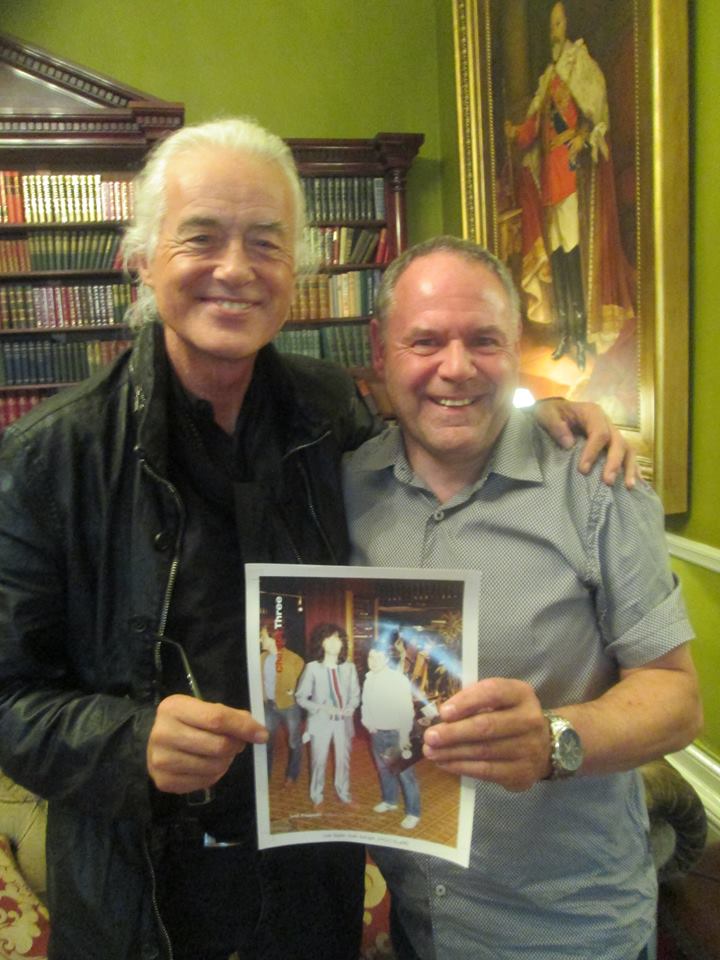
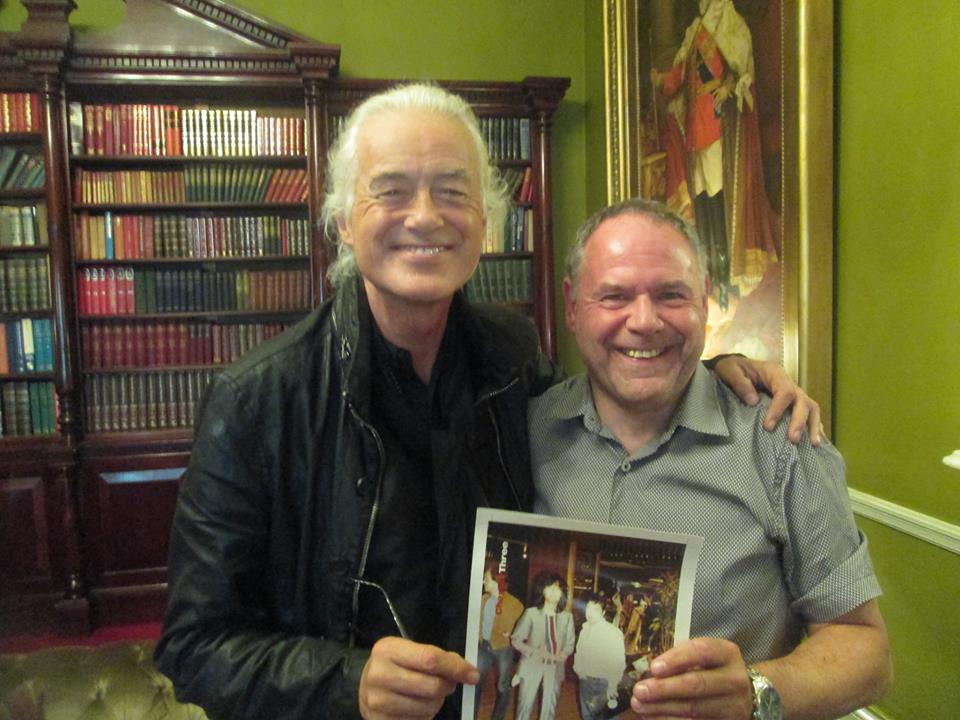
As we both posed for a ‘then and now’ photo, he laughed, ‘‘We look a whole lot younger then!”
Younger then and older now, but neither of us any less fervent for the band – his band, that really is a way of life.
‘’Thanks for all your enthusiasm, Dave’’ is his parting shot. No, Jimmy… thank you for all yours.
Back out in the bar area, as the next journo is ready to go in. I clock a look at the framed pics of the food splattered Rolling Stones, taken in this very building at their Beggars Banquet album launch back in 1968.
Then a walk across the road and a final glance over at Albert’s place. It’s been a long day and maybe it’s all in my head but I’m sure I could hear the strains of an instrumental version of Stairway To Heaven, (ala the 1983 Arms arrangement) coming from within the confines of this lovely old building.
After the interview I headed over to Euston to see my lifelong friend Dec for a beer or two and and boy did I need it. Dec has been listening to my Zep tales for over 40 years. We laughed when we recalled one story – this would have been 1974. Dec being an avid singles collector played a single by Neil Christian and the Crusaders down the phone to me to decide if Jimmy was on it.
I was in a public telephone at the time as we had no home phone. The things we did back then in the name of extending knowledge of the guitarist. The one I’ve just interviewed. In my wildest dreams I could never have foreseen this situation occurring back in 1974.
Years later, that night at the Royal Albert Hall back in 1983 signaled something of an artistic rebirth for the man. During our interview earlier, hearing his desire to get back out there and be seen to be playing again, well, I have a feeling another rebirth is on the way. In fact, it strikes me that the grand old building would be and appropriate setting for such a return. Here’s hoping.
Clearly Jimmy Page still has the passion for his music. That much I know, because I have just experienced that passion firsthand..
Dave Lewis – October 8th, 2014.
Postscript – January 2026:
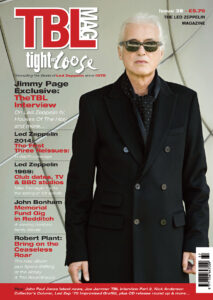
That really was an incredible afternoon back in 2014 – Jimmy was incredibly gracious and empathetic throughout our time together and the resulting interview as published in TBL issue38, was for me an ambition achieved. What a memory and amazingly, I would go on to interview Jimmy again the next year.
Dave Lewis – January 14 2026
———————————————————————————————————————————
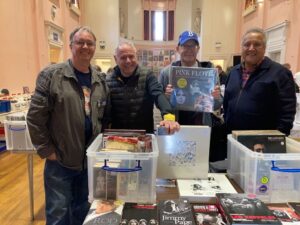
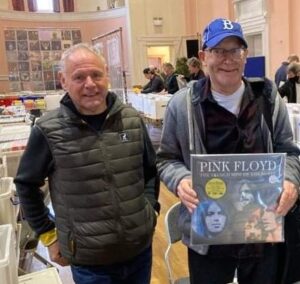
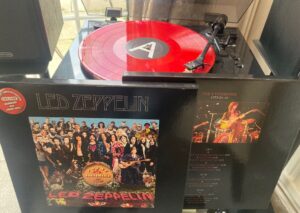
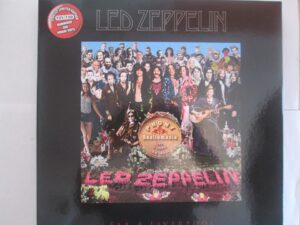

Until next time…
Dave Lewis – January 14 2026
TBL website updates written and compiled by Dave Lewis
Follow TBL/DL on Facebook:


 (No Ratings Yet)
 Loading...
Many thanks Roy
take care dave
Leave your response!
TBL Products
About TBL
Tight But Loose Website edited by Dave Lewis and Gary Foy.
Tight But Loose Magazine created by Dave Lewis 1978. TBL/Web launched by Dave Linwood 1995. TBL logo by Mike Warry.
All written material and photographs are copyright © Tight But Loose. Not to be reproduced without prior permission.
Tight But Loose welcomes input / info / tour reports / CD reviews / CDR’s & Tapes on any Zep related topic past and present.
Archives
Recent Posts
Recent Comments
Tags
Views