



REMASTERS BOX SET IT WAS 36 YEARS AGO/MORE REMASTERS MEMORIES/JIMMY & MACCA/ZEP & KING CURTIS SINGLE/PRIORY OF BRION IN A TENT 27 YEARS GONE/WALKING INTO EVERYWHERE IN THE UK 1998/JAPAN 1971 & 1972 UPDATED ARTICLE/ WH SMITH 52 YEARS AGO/DL DIARY BLOG UPDATE

Led Zeppelin Remasters : 36 Years Gone…
Another anniversary the Remasters releases all of 36 years old this week. I absolutely loved that period – it was so incredible to see the resurgence of interest that surrounded them – here’s some 36th anniversary thoughts…
Led Zeppelin Remastered…it was 36 years ago…
It’s amazing to think that there was a time back in the day, that the only way of hearing Led Zeppelin’s music was via the ten original albums – ie the eight original studio albums, The Song Remains The Same soundtrack and the posthumous collection Coda.
There were no greatest hits albums, no BBC sessions, no 1972 live albums and certainly no i-tunes, Spotify HD downloads and streaming.
True the Led Zeppelin catalogue had been released on CD – though not from the original masters and transferred via analogue tapes. The results were mixed. I did a feature in Record Collector in early 1990 reviewing the original CD’s (I’ll need to dig that one out) ,blissfully unaware that Jimmy was about to overhaul the entire catalogue for CD.
Thus the arrival in October of 1990 of the five LP CD box set and double Remasters compilations was a very big deal indeed.
I wasn’t the only one I am sure, who had not paid much attention to the studio albums in recent years. My Zep listening time was taken up analysing the many Zep shows that were appearing on CD sets and the fresh outtakes that had surfaced.
The arrival of the Remasters was a revelation. Suddenly we all realised just exactly what it was that had made this band so special.
Lapsed fans got back on the wagon –a whole new generation of younger enthusiasts also jumped aboard. Overnight Led Zep’s stock shot up…and it never looked back.
The Remasters releases were absolute game changers in the way Led Zeppelin were viewed and appreciated.
I have very fond memories of this period – it was the point where I realised their legacy was intact. It was fantastic to follow all the media buzz that went with it including Jimmy’s appearances on MTV and the promo videos for Travellin Riverside Blues and Over The Hills And Far Away.

In the Our Price record store I managed Bedford we really went to town – with pre release build up and in store displays. This activity resulted in the store racking up £10,000 worth of business on the box sets and double albums. I was later awarded a triple gold disc award by Warners in the UK. Here’s a pic of the shop window in November 1990.
Like I say, I was about to produce a book that emphatically chronicled the band’s music. The book Led Zeppelin – A Celebration published the next summer was very well received…and it set me on a mission to totally commit myself to chronicling the world of Led Zeppelin that has not let up for the past quarter of a century.
This is something I wrote at the time for Record Collector. I remember putting this together – the words came tumbling out such was my enthusiasm for it all – and it remains one of my favourite pieces of writing on the band.
I’ll be bringing out the Remasters box set vinyl and CDs to enjoy over this weekend reveling in Jimmy’s vision of – as he put it ”The same picture with a different frame”
And what pictures they are….

DL
Here’s my feature that ran in Record Collector in December 1990…
LED ZEPPELIN REMASTERED…
DAVE LEWIS REVIEWS JIMMY PAGE’S DEFINITIVE COMPILATIONS OF ZEPP’S BACK CATALOGUE
Earlier this year, I summed up my feature in Record Collector on Led Zeppelin On CD by offering Atlantic Records the following advice: “In the light of the shortcomings of the Led Zeppelin CDs, it would be good to see Atlantic embark on a re-mastering job to eliminate some of the errors that have occurred. An even better idea would be for Jimmy Page himself to oversee such a project which could easily take the format of a special box set release. Atlantic Records take note!”
At that time, I was unaware of Atlantic’s plans to produce just such a set, so it came as a pleasant surprise to learn that my request was about to become a reality. The project began to take shape when Jimmy Page was approached by the label to remaster the original Zeppelin catalogue for a compilation release. Dissatisfied with the general reproduction of the available CDs, Page jumped at the opportunity to restore his old masters to the standard he envisaged. Studio time was booked at New York’s Stirling Studio in May, where Jimmy spent a week with engineer George Marino digitally transferring the material from, in most cases, the original two-track master tapes.
The project in mind was a multi-track box set release for which Page drew up possible track listings for the other two ex-members to sanction. “I really wanted to improve the release”, Page is quoted as saying on the officially press release; “basically it’s the same picture with a different frame”. John Paul Jones added: “The songs sound as fresh now as when they were first recorded, and the new positions in the running order seem to put them in a totally different light.”
The original concept was to package 54 remastered tracks in a deluxe box package with a 36-page book of photos and essays. Atlantic’s European distributors East West were supremely keen to also issue an edited version aimed at the mainstream market. And so a condensed version with 24 tracks on a triple album and 26 on a double cassette and CD was also prepared — for Europe only.

This release, under the title “Remasters”, formed the major spearhead of WEA/East West’s Christmas market campaign. After all the years of avoiding the greatest hits treatment, the Zepp catalogue received the full commercial push as East West undertook a massive marketing campaign to back to October 15 release of “Remasters”. Window displays were installed, including inflatable blimps which are sure to join earlier models as collectable Zep items. Mysterious teaser adverts appeared in the music press depicting the shadow of the Zepp airship looming over several international locations, recalling the similar obscure ads placed as a trailer for the band’s fourth album. Even a TV advertisement was prepared, set to appear on screens across the country in the run-in to Christmas.
COMMERCIALISE:
But East West did fail in the final quest to fully commercialise this “Remasters” package: they did not receive the blessing of Page, Plant and Jones to issue a U.K. single. The plan was to issue “Stairway To Heaven” on December 2 as a four-track CD single and 12″ picture disc, with “Whole Lotta Love”, “Immigrant Song” and “Good Times Bad Times”. Although the classic Zep anthem would have been a strong contender for the Christmas No. 1 spot, the no-U.K.-singles rule prevailed. This collection of tracks subsequently surfaced in two already well-in-demand U.K. promo items. The first is a four-track 10″ pressing (Atlantic LZ 2), housed in a black sleeve depicting the specially commissioned Mission Control-designed colour illustrations that mirror the images of the band’s famous four symbols. There is also a four-track promo CD single (Atlantic CD LZ 1), packaged in a cardboard oblong box. Both items are definitely prime additions to any Led Zeppelin rarities collection.
The condensed “Remasters” set duly surfaced on schedule, and entered the U.K. album chart at No. 10. As a layman’s introduction to the group, its track listing does include the majority of Zepp classics, though I was surprised to find that “When The Levee Breaks” and “The Ocean” — two tracks which have been heavily sampled by other artists, and have this found their way to the forefront of the Zepp canon over the last decade — had both been omitted. I personally would have viewed these tracks as more historically representative than lesser stepping stones such as “Celebration Day” and “Houses Of The Holy”
While there can be little complaint about the overall musical content of “Remasters”, or the typically offbeat sleeve design concept of the Zepp shadow looming over a mysteriously carved cornfield, the lack of any track details on the sleeve is a disappointment. Despite the fact that Atlantic’s press release for the condensed set promised “extensive sleeve notes” on the vinyl edition, purchasers of “Remasters” are afforded none of the intensive recording data to be found in the box set booklet. There is not even any indication as to which album each track came from. As the set is obviously aimed at the less committed fan, surely this would have been a simple device to draw attention to the entire Zep catalogue.
Unfortunately, omissions such as these present “Remasters” as something of a cold marketing ploy issued to cash in on the peak consumer period. Compared to the deluxe box set package, it certainly pales considerably. At nigh on £20 a throw, “Remasters” should have been presented with far more information, and some additional alternate photos. That’s particularly the case, given the fact that completist collectors will need this set as well as the extended box, as it strangely contains one remastered track not to be found anywhere on the box set — namely the first album opener, “Good Times Bad Times”. The fact that all the different formats of “Remasters” are scheduled to be deleted on March 31 1991 will also add to its desirability to the keen Zep enthusiast.
And now to the box set itself, simply titled “Led Zeppelin”. This is beautifully packaged in a strong 12″ box with a slightly different view of the ‘Zepp over cornfields’ scene. The accompanying 36-page book is also of superb quality and contains some wonderful photos. The three essays by noted American critics Robert Palmer (who coincidentally also wrote notes for the Rod Stewart “Storyteller” set), Kurt Loder and Cameron Crowe are admirable summaries of the band’s career. However, for all his “front row seats to the Zepp experience”, Crowe manages in the space of eight pages to document wrongly the date of the release of “Houses Of The Holy” (March ’73, not May), the date and location of their meeting with Elvis (L.A. in May ’74, not Las Vegas in 1972), the date they flew to Stockholm to begin recording “In Through The Out Door” (November ’78 not January), and the date of Live Aid (July ’85, not ’87).
While it’s great to see a full track rundown of when and where each track was recorded, some errors again creep in. Two of them can be put down to the confusion some researcher had about the different way dates are printed in the U.K. and U.S. — the recording date of the Albert Hall rehearsal take of “I Can’t Quit You Baby” was actually January 9 1970 (9/1/70 in U.K. usage) and not September 1 1970 (9/1/70 in American eyes). Similarly, the recording date of “Bonzo’s Montreux” becomes December 9 1976 instead of September 12. Elsewhere, printing gremlins creep in on the “Gallows Pole” entry which has it being recorded in 1972 and released on “Led Zeppelin 3” in 1970. I would also question the actual release dates^ of some of the albums in the U.S. discography — the soundtrack album, for instance, being a month out. This may seem like nitpicking, but I cannot be alone in finding such errors annoying, particularly as “Led Zeppelin” was designed as a definitive retrospective.
And the music? In compiling 54 tracks, Page was faced with the difficult task of knowing what to leave out. Obviously everyone has different favourites and a set list like this is always going to be disappointing. For me, the biggest letdown is the lack of tracks from “Physical Graffiti”, by their own admission Led Zeppelin’s premier achievement on record.
But what is included is a truly wondrous cross section of the musical diversity that coloured the Zeppelin catalogue during their 12-year reign. In remastering the tracks, Page has added a punch and clarity that the original CDs sorely lacked — without tampering with the original tapes, so there is no remixing here aside from the new Bonzo creation, which I’ll come to in a moment. The cleaning-up of the analog tapes also greatly helps the light and shade of tracks like “The Battle Of Evermore” and “Ten Years Gone”, while Page has restored the correct studio banter to the ending of “In My Time Of Dying”.
SURPRISES:
Some of the anomalies and surprises to be found in this mammoth collection include the fact that the timings of many tracks here are vastly different to the claims on the original albums. For instance, “Kashmir” (previously listed as 9’41”) now appears as a correct 8’31”, though the tracks are absolutely identical. The only piece amongst the 54 which I have noticed being different to the original is “Nobody’s Fault But Mine”. The “Remasters” take is 12 seconds longer than the “Presence” original due to the inclusion of an extra guitar riff chorus on the intro. Elsewhere, the three-second white noise count-in on “Immigrant Song” is deleted here, as is the eight-second intro to “Tangerine”. But the warming up of guitars on “Black Dog” is present, and sounds much more pronounced than before.
It’s interesting to hear familiar classics placed in a different light — “Heartbreaker” now segues instantly into “Communication Breakdown”, for example, rather than “Livin’ Lovin’ Maid”, while “The Song Remains The Same” drifts into “Ten Years Gone”. The sequencing of the tracks does, as John Paul Jones noted, put them in a new context.
Finally, some new delights. In merging John Bonham’s “Moby Dick” with his later “Bonzo’s Montreux”, Page has produced an affectionate tribute to the late drummer, achieved with Synclavier programming at Atlantic’s studios in New York earlier this year. Some might question whether he should have tampered with the originals, but the finished track mixes elements of Bonham’s developing technique over seven years. It’s also a joy to hear the “Zepp 3” leftover “Hey Hey What Can I Do” — a warm semi-acoustic groove previously only available on the B-side of the U.S./European “Immigrant Song” single, and on the long-deleted “New-Age Of Atlantic” sampler LP.

Also included are two much-bootlegged BBC recordings, which sound superb. “Travelling Riverside Blues”, a Page/Plant arrangement of the old Robert Johnson blues classic, is a prime mid-’69 remnant with a spiralling Page slide guitar riff and some dominant Bonzo bass drum patterns — all now heard to their full effect for the first time. “White Summer/Black Mountain Side” comes from the live Playhouse Theatre show recorded on June 27th 1969, and brings back many nostalgic Zep memories.
Of course, there will be a school of thought that Page should have used this box set project to issue more unreleased gems — many of which have turned up on top quality bootleg CDs over the past year. There was also scope here for the much vaunted chronological live album idea which Page often hinted at in the latter Zepp era. Though there may be few fully-fledged studio tracks with finished vocals in the vaults, recent bootlegs have proved that there are some tantalising alternate takes which would have added spice to the set. “Led Zeppelin” is superb in its own right, but many enthusiasts will view it as a missed opportunity to hear more enlightening live and studio cuts. Certainly one CD of rare material would have made the whole thing much more worthwhile.
My personal choice of a bonus rare CD of material which is known to exist would have lined up like this: “Communication Breakdown” (live Royal Albert Hall, 1970); “Jenning’s Farm Blues” (electric studio rehearsal of “Bron Y Aur Stomp”, 1969); “Blues Medley” from the “Hats Off To Harper” session (1970); “No Quarter” (instrumental studio out-take, 1972); “Over The Hills And Far Away” (live in Dallas, 1975 U.S. tour); “Tangerine” (live, Earls Court 1975); “Trampled Underfoot” (live, Earls Court 1975); “The Song Remains The Same/Sick Again” (live, New York 1977); “Ten Years Gone” (live, New York 1977); “Train Kept A-Rollin’ ” (live, Zurich 1980); “All My Love” (alternate extended version, 1978). But maybe Jimmy is saving that lot for the “Re-Remasters”!
Overall, despite the misgivings about the track listing, some irritating errors in the booklet and the difficulty of pleasing collectors old and new, the “Led Zeppelin” box set is a worthy investment, and compares well with similar packages by other artists. Certainly, in restoring the Zeppelin catalogue to CD with the sound quality it deserves, Page has done a superb job. With the incredible resurgence of interest in the band in recent times — they must surely be the most popular defunct band outside of the Beatles — the set is sure to be in huge demand.
This collection will stand as a lasting testament to the sheer diversity of Zeppelin’s recorded work. It should also prompt re-examination of epic works such as “Achilles’ Last Stand” and “In The Light”. The latter track’s final few minutes, capturing Jimmy’s overdubbed guitar parts rippling across Robert’s chorus, the Jones drone and Bonzo’s timely hammering, is perhaps the most impressive section of the entire 54-track set. And it sounds glorious.
Will they reform? Will there be a live chronological video to supplement this release sometime next year? The remastered “Led Zeppelin” set should keep all Zepp fans riveted to their turntables as we await the next chapter in a story that is far from over.
Dave Lewis – October 1990
Dave Lewis is the author of a forthcoming book on Led Zeppelin titled “Led Zeppelin — A Celebration” (to be published by Omnibus Press, spring 1991).
First published in Record Collector December 1990
More Remasters Memories:
It was 36 years ago…

The scene in the Our Price record shop in Bedford that I managed 36 years ago – for on October 15, 1990 the first ever Led Zeppelin compilation set was released – the double album Remasters,.to be followed two weeks later by the 4LP/CD box set. It opened up Zep to a whole new market..and boy did we sell some Zep product as Colin Stonebridge, Justin Cromie and Jason Foster will remember…great music retail days they were…
It was 36 years ago 2:

The scene in the Our Price record shop window in Bedford on this day 34 years ago this month – for on October 15, 1990 the first ever Led Zeppelin compilation set was released – the double album Remasters..to be followed two weeks later by the 4LP/CD box set.
As I had a vested interest (I was writing the Led Zeppelin A Celebration book a the time) I made sure we racked up the sales – much of the window came from my collection – including that rather splendid Japanese poster of Jimmy Page on the right…all this contributed to me being awarded a triple gold disc by Warners for my efforts to ensure Led Zeppelin were right back at the forefront of record, CD and tape buyers…where they have remained ever since
It was 36 years ago 3:


Remasters Led Zeppelin Exclusive Our Price Bedford Memorabilia Pack:
To create something of an exclusive for buyers of the Led Zeppelin box set at the Our Price record shop I managed in Bedford we created a special Led Zeppelin memorabilia pack to give out to buyers of the set -100 only all individually numbered.
Under the title ‘Our Price Remembers Led Zeppelin’ the pack contained a number of facsimile reproduction Led Zep ads and cutting. These were drawn from my collection and I took them to the local photo copy shop Jaycopy (who had produced the early TBL magazines). It took hours of cuttings out to produce the 100 sets. I also wrote a three page 54 FACTS BEHIND THE TRACKS guide drawn from material in my then in progress Led Zeppelin A Celebration book the book – this was photocopied off my word processor. The outer envelope was designed by the then assistant manager at the shop Colin Stonebridge. This all went down very well with local buyers as we sold over 100 sets in the first week at £54 a throw.


The triple gold disc I was awarded by Warner Music in the UK for my contribution to the sales of the Remasters releases –notably the £54 priced 4CD/LP box set –in the Our Price Store I managed in Bedford we generated over £10,000 sales during the opening weeks of release… not bad for a store of just 980 square feet. Great retail days they were…
Dave Lewis – October 2025
—————————————————————————————————————————————————————
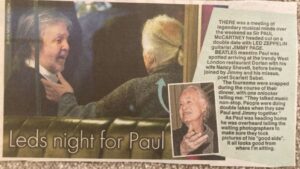
Jimmy Page with Paul McCartney…
As reported in The Sun last Monday….
———————————————————————————————————
Another rare Whole Lotta Love single…
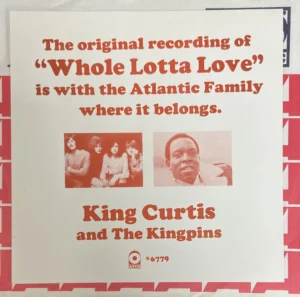
I got this info via Gary Johnson at Rockaway Records..
1970 mono promo-only 45 with Led Zeppelin version (3:12) on one side and King Curtis And The Kingpins version on the other. Includes extremely rare 6″ x 6″ card stock one-sided picture cover/insert, which pictures both Led Zeppelin and King Curtis. This is the only copy of this mega rare insert we have ever seen. We only know of one other that was ever sold and it’s possible that the sale may have actually been this exact one. Truly one of the rarest US Led Zeppelin items there is.
That is certianly a new one on me and what a find – more details below:
—————————————————————–
Priory Of Brion in a tent – It was 27 years Ago:

Earlier I had met the enigmatic and legendary Leicester based musician Kevin Hewick who was leading me with all good intentions on this wild goose chase(Hi Kevin!). He had heard that Robert and The Priory Of Brion were booked for an appearance at the Ashby Del La Zouch Folk Festival in a tent in Moira near Leicester. It sounded the perfect way to spend a Halloween afternoon.
This was an era when if Robert Plant was playing a gig, I would move heaven and earth to be there.
However our taxi driver host was finding said location very hard to locate. Where were sat navs when we needed them, or for that matter mobile phones?!
Anyway, thankfully it all came good – we found the venue and the tent with about fifteen minutes to spare…and on a pleasant Sunday afternoon Robert duly delivered one of the most captivating gigs I’ve ever seen. Witty, relaxed, reflective and singing with passion and verve the songs that as he put it, he’d had stored in his back pocket. It was an absolute joyous occasion. – pic below by Krys Jantzen.

Robert Plant in a tent on a Sunday afternoon….whatever next? How about Robert Plant on a Saturday night in a pub lounge bar because bizarrely that’s what was in store two weeks later when we saw him play at the Red Lion in Birmingham.
The Ashby Del la Zouch and Red Lion shows remain right up there in my all time best gig going experiences. I’d also like to mention that back then the wonderful much missed Hayley Martin was looking after the Our Price shop in Bedford that day enabling me to go on this mad escapade -one of many days that she did that for me . These memories would not have been possible without her loyalty and kindness.
Dave Lewis – October 2026
TBL Archive:
THE WALKING INTO EVERYWHERE TOUR WATCH DIARY
A look back to the Page & Plant activity from August to October 1998…
August was going to be a busy month. Page and Plant had already been confirmed as headliners for the Friday, August 28, Reading bill with additional European festival dates lined up alongside a date at Dublin’s The Point two days before Reading.
WEDNESDAY AUGUST 26 1998
Dublin
It’s pretty hectic down the front but stimulating to say the least as they leap into the set with abandon. No major changes early on, the initial highlights being a very fluent ‘No Quarter and the standout moment of the set ‘Shining In The Light’. This for me has entered the category that might loosely be dubbed “The new Zeppelin canon”. It’s the sort of thing that would have lit up the 1981 Zeppelin album had it been written then. And they perform it tonight with such spark, Plant with mike off and Jimmy skipping around towards the speeded-up finale.
‘Heart In Your Hand’ also shines tonight despite it’s low key nature. It’s sung intensely by Plant as if he is living every aching word. ‘Babe’ is its usual dynamic self and ‘How Many More Times’ swaggers along with an extended ‘In The Light’ middle section. ‘Most High’ is just that and there’s a no nonsense finale leaden with the classics that are ‘Whole Lotta Love’, ‘Black Dog’ and ‘Rock And Roll’.
“Maybe we’ll see you at one of those weddings,” is one of Plant’s final comments to the crowd – a reference to the informal live appearance they had made three weeks earlier in Co. Kerry at lighting designer Tom Kenny’s wedding.
Witnessing this show it’s apparent that there is now a real consistency of performance. Some 46 gigs along the way, this Page Plant tour has reached a real peak. In the current edition of Mojo, Matt Snow remarked that Page and Plant might well be the most exiting live rock band on the planet right now.
Tonight in Dublin that statement can be uttered with absolute conviction.
On the way out I see a guy who had been proclaiming The Edge as his hero earlier. “You were right!”’ he shouts over, “Jimmy Page is the one!”
FRIDAY AUGUST 28 1998
Reading Festival
Luckily the weather is favourable, not over sunny but no sign of rain. So anticipation is high as we mingle with the crowd underneath the giant stage. An American fan nearby is telling how effective they were when he caught up with the show in Philadelphia in the summer. “When did you last see them?” he asks… “Er, two days ago actually,” is my unintended conceited reply. Underneath the stars, the familiar Egyptian music booms out, they stride on and with no messing we are into ‘Wanton Song’. Adorned in familiar dark attire they look fit and eager to fulfil their bill topping status.
“We’re in the presence of legends!” is one excited teenagers repeated cry behind me. By the time they’ve romped into ‘Heartbreaker’ one thing clearly strikes me. This is a clear case of men against boys. I mean, really. For all the good intentions of the others on the bill, the experience and sheer power that these old veterans convey is startling. It makes for a great couple of hours. Sadly ‘Shining In The Light’ is dropped in favour of ‘Burning Up’ though it’s good to hear that again. The video screens to the left and right of the stage convey some great images, causing a shiver down the spine and clear memories of Knebworth when the violin bow appears to the left of me, high and mighty on the big screen. A ‘Babe I’m Gonna Leave You’ that touches the nerve ends and a sure fire ‘How Many More Times’ with a regal sounding ‘What Is’ insert, ‘Whole Lotta Love’ and encores of ‘Black Dog’ and ‘Rock And Roll’ are duly delivered in stadium filling soundscape mode. The reception across the darkness confirms that this has been a very shrewd decision. Reading rocked and it was great to be there to witness it.
And to top it all Wolves have taken the points at Watford as Plant remarks “It’s 2-0 down at Vicarage Road.”
PRE-UK TOUR AUTUMN SUMMARY
There’s absolutely no let up as we move into the autumn. The rumour machine has been in overdrive with news of secret warm-up dates slated for Brighton, Wolverhampton Civic Hall, Oxford… you name it. In amongst all the rumours there are plans for P&P to do some sort of show to tie in with a new sponsorship deal with Molson beer in Canada.
FRIDAY OCTOBER 30 1998

“Tomorrow it’s Barnsley at home”
Some days are very special in the Zepp related scheme of things, and this is definitely one of them. Aside from the events that will unfold in London tonight – at home in the morning I take a call from John Paul Jones, interviewing him for Record Collector.
The gig itself is at the University Of London Union. The audience is made up of about 300 Canadians who have scooped a prize to see Page and Plant in London, courtesy of Molson Beer. The remaining 200 are made up of various record company staff and invited guests. Very kindly, I have been invited and have been given passes for myself, Janet and a few others and in the afternoon, Janet and I travel to the Trinifold management offices in Camden to pick up.
The hall is situated deep inside the University building, very small, a main stage and an open plan hall that would accommodate only the first front block of Wembley Arena.
Down the front there are a few Canadians milling around. Few of them seem to be hard core fans and they are pretty laid back about it, though the presence of the English contingent soon ups the enthusiasm. In a year when I’ve enjoyed some very close associations in front of Page and Plant, this is an incredibly exciting way to round it all off. The place reminds me of the set-up at Leicester University when Plant played a warm up there back in January ’88. I consider that night one of the best evenings of live music I’ve ever witnessed. Tonight could be similar.
There’s a short pre-announcement from one of the University staff… and then, with no fanfare or Egyptian music, on they walk. “Welcome to the party,” says Robert as he adjusts the mike. Plant is in a light blue and white striped long sleeved shirt worn outside, Page in black, and it’s straight into ‘Wanton Song’. It was like seeing them at the local youth club. They might have performed slicker shows along the way but for sheer in-your-face out-an-out live experience this really was special. The fact that they get lost a little half way through ‘Heartbreaker’ matters little – this is spontaneous rock’n’roll, warts and all.
Watching Jimmy ring every last note out of the ‘No Quarter’ solo inspires simultaneous “Best since Earls Court” exclamations from Phil T and myself. ‘When The World Was Young’ is a stand out. From the first moment I heard it on the album this one begged for live performance and like all their great live deliveries they adapt it by adding various delightful twists and turns. Plant’s repeated “Wohoa” refrains before the chorus (not unlike the vocal “aha-ah” effect on ‘Achilles’) and Jimmy’s extended solo puts this track right up there with the best musical moments of the whole Page Plant reformation. The way the solo swells up and then levitates, spiralling upwards and out in a manner that was only hinted at on the album is simply awe inspiring.
Other notable moments: ‘Going To California’ with it’s ‘32-20 Blues’ insert, an intense ‘Heart In Your Hand’, ‘Babe I’m Gonna Leave You’ which has Plant nearly missing a cue and a strange incident when part of the lighting rig drops next to Charlie, much to Plant’s amusement. There’s also a stomping ‘How Many More Times’ with ‘Boom Boom’ insert. When they march off stage you get the feeling that there may be some set list surprises on the way.
And surprises there certainly were. When Phil Andrews takes to the keyboard when they come back on I was expecting ‘Thank You…’. Wrong. Come in ‘Misty Mountain Hop’, played for the first time since the opening night in the US back in May. A quick tune up from Jimmy and ‘Trampled Underfoot’, its first complete airing by Page and Plant since Hammersmith in 1988. And there’s new life in the old dog as Plant immediately takes up the challenge – throwing in a classic clenched fist shape each time the riff rolls around. A glorious noise to behold.
And if that wasn’t enough here comes an epic speech: “This is a new song, well not new, it’s just that we’ve never done it before and it’s incredibly old and there are bits of it we’re not liking that much yet… so we’ll see what happens!’’
Very soon I can trace out that revolving riff that lit up the opening track on side four of Physical Graffiti all those years ago. Robert’s opening line confirms it – “I received the message from my brother ’cross the water he sat laughing as he wrote the end’s in sight.”
A piece of Zeppelin history unfolds as Page and Plant perform the first ever a live version of ‘Night Flight’. Always one of my all time faves, I’ve waited nigh on 24 years to hear them play it on stage. Bedlam ensures. ‘Rock And Roll’ follows in a blur and they’re off. Not before Robert has reminded us that tomorrow is match day. “Thank you very much… it’s Barnsley at home tomorrow.”
Dave Lewis October 1998
To Be continued…
Led Zeppelin in Japan: a few things not known across the sea (Part 1: 1971) UPDATED:
On TBL October, 7 my two-part article titled “Led Zeppelin in Japan: a few things not known across the sea” appeared. That was the repost of the identical article posted on TBL 8, October 2025.
Unbeknown to Dave Lewis, I was updating the contents with the imminent post to TBL in my mind. I contacted Dave and asked if he didn’t mind posting the new version so here it is. My sincere apology to Dave and the readers for the duplicated post of the largely same article but with some added information. — Hiroshi
Led Zeppelin in Japan: a few things not known across the sea (Part 1: 1971)[updated: Oct 2026]

New Music Magazine, September, 1971 issue (out in the shops late August)
“Led Zeppelin are coming” feature. Report on the last minute cancellation and the subsequent resume of the tour.

New Music Magazine, November, 1971 issue (out in the shops in late October)
Two articles reporting the Japan tour: “The Airship Troopers Storm Japan” by Ichiro Fukuda — who quotes Robert’s harsh comment on the Berkeley crowd — and “Blown Away By Zeppelin” by Toyo Nakamura, the editor in chief. Both writers attended all of the five shows.
“The prevailing opinion is that Osaka first night was the best show, which I am partial to.” (Nakamura)
Two articles reporting the Japan tour: “The Airship Troopers Storm Japan” by Ichiro Fukuda — who quotes Robert’s harsh comment on the Berkeley crowd they played to only recently (13 and 14 September) — and “Blown Away By Zeppelin” by Toyo Nakamura, the editor in chief. Both writers attended all of the five shows.
“When we went down to San Francisco and played at the theatre in Berkeley, the attitude of the audience was so poor — in the beginning they were quite inattentive, but once somebody stood up and started shouting, everybody followed, stood up and shouted, “More! More!” in the end. We were so disappointed.” (Robert Plant, supposedly given during the welcome party held at Hotel Hilton Tokyo after the press conference in the afternoon of September 22)
“The prevailing opinion is that Osaka first night was the best show, which I am partial to.” (Nakamura)
Come Autumn, it is the time to reminisce about Led Zeppelin’s two consecutive Japanese visits 1971 and 1972. Six years ago, I submitted two-part article to TBL (dated 1 and 7 October 2020), which provided the readers with some unknown information outside Japan. I updated it with a few tweaks and corrections, amending factual errors and adding new information, which was published on TBL, 8 October, 2025. Here is a further update version as of now, Year 2026. Hope you enjoy these pieces and get some enlightenment from my writing.
Led Zeppelin’s Japan tour 1971 was one of their most memorable and full of incident. Such happenings and tales, fascinating as they are, have not been fully reported abroad due to the language barrier. Here is an attempt to get across some of them for the convenience of the overseas readers. For this purpose, the photo book, Live Tour In Japan 1971 & 1972 (Shinko Music, 2019), served as a great source of information, among others. I would like to thank all who are concerned.
As is often the case with all things Zeppelin, Ahmet Ertegun played a big roll in materializing the group’s tour of Japan. When Warner Pioneer Inc. was founded (dated November 11, 1970), the distributorship of Led Zeppelin records in Japan was transferred from Nippon Gramophone to them. Ertegun flew over to Japan to attend the press conference for the company promotion, where he declared he would make Zeppelin’s Japan tour happen. It did.
The concert tickets were to be released on August 5. However, in the evening of the day before, the 4th, the news of the tour’s cancellation at the last minute was aired over the radio out of the blue, which gutted the fans. The story goes that due to John Paul Jones’ sudden illness, the U.S. tour that preceded the Japan dates would have to be entirely rescheduled, and the promoters, Kyodo Tokyo, came to the conclusion that the tour had better be withdrawn as quickly as possible to avoid the predictable mess. Kyodo office was flooded with protesting phone calls from the distraught fans the next day. The promoters started a further negotiation with Ertegun by international call, and at the end of the day, both sides agreed to give the go-ahead for the tour as initially planned — a little drama was unfolded below the surface until the matters settled. The tickets finally went on sale on the 9th. Today, this whole scenario sounds rather dubious as there are no such records as the said rescheduling of the U.S. tour left anywhere. The true reason aside, had the tour had actually been cancelled, there is a fair possibility that it would have been tacked onto the Australia/New Zealand tour 1972, and the group’s legendary Japanese saga would have surfaced as a whole different story from what it was.
For their 1971 visit, Led Zeppelin were initially scheduled to arrive in Japan in the afternoon of Tuesday September 21. They then informed the promoters in Japan that they changed the plan and would arrive on the 20th. As it turned out, Page, Bonham, Grant, Cole and Carson flew out from Hawaii on Saturday 18th, the day immediately after finishing the two shows in Honolulu 16-17, and landed at Tokyo Haneda Airport at 15:25 on Sunday 19th. Next day, they turned up unexpectedly at the Warner Pioneer office in Roppongi in the morning without notice, taking the record company staff by surprise.
After spending another couple days for the rest and vacation in Hawaii, Plant and Jones flew in to Haneda Airport later than the other group, in the evening of Tuesday 21st, to be greeted by the rest of the team who had already entered Japan. Outside the arrival gate, Bonham was seen holding an Akai video recorder in his hand, apparently for professional use, that he had purchased in the afternoon. The cumbersome video tape deck hung from his shoulder weighed approximately 10 kg! He was caught in the pics from the later dates carrying a more common Super 8mm camera that was handier to use.
Mr. Setsuo Yamada (b. 1898 – d. 1975), the mayor of Hiroshima-city at the time, after graduating Tokyo University, studied at Oxford Uni in the pre-WW2 times thus spoke fluent English. In his office, he talked to the members of Zeppelin without an interpreter, which must have impressed them. He also attended the group’s show that night, only to leave the seat after a short while, due to the ear-shattering volume…or so the story goes.
It is mentioned in November 1971 issue of the Music Life magazine that Japanese guitarist Shigeru Narumo gave Page a custom-made electric guitar [Greco product] as a present and he used it at the Osaka show. It is unclear which date and what song(s) he played with it, but the educated guess among the enthusiasts is that Rock And Roll, the final encore number on September 29, might be it.
The anecdote Richard Cole described in his Zeppelin bio, Stairway To Heaven;
…about four minutes into the song, he [Carson] suddenly realized that his bass was the only instrument he was hearing. He quickly looked around – and he was alone on the stage. As a prank, the band had snuck off in the middle of the song, leaving Phil to fend for himself. He made a valiant attempt at a bass solo, but he gave up once it was clear that the guys weren’t going to rescue him. Phil put down his instrument and ran off the stage, too, as the band rollicked in laughter.
No such act of ridicule happened. Sure, Atlantic executive Phil Carson played the bass instead of Jones, and tour crew Clive Coulson joined the chorus, on C’mon Everybody for Osaka first night’s encore. As you hear on the audience recordings, Led Zeppelin played through the song without pause. And finishing the performance, Plant introduced both people, calling out their names proudly. Wrong remembrance or pure make-up by Cole.
After all these years, I observe from time to time a debate among the fans outside Japan whether not only the Osaka shows but also the Tokyo shows were properly recorded or not. They were. In Japan, nobody doubts it one bit from back in the day. In November 1971 issue of the New Music Magazine, it is reported that “both two Tokyo and two Osaka dates were recorded in 8 tracks and Page took back the tapes.” It is argued in some quarters that the shows were recorded in 6 tracks, but the staff member from Warner Pioneer who was in charge of the live recordings mentioned in the article published in January 2013 issue of the Crossbeat magazine that they used a combination of two 8-track, 2-inch reel-to-reel tape decks for the task. In the same article, he also revealed that he diverted the signals via split cables to make a separate recording of the final show (September 29) as the record company wanted to keep it for posterity.
The tapes were then kept and looked after in the storage of Apollon, the company that manufactured music tapes exclusively (including Warner Pioneer catalogues), and someone copied and leaked them, which eventually became the source of the famous bootleg, Live In Japan (also known as Live In Japan 1971). The first-press double LP of the lower-pitched version was out towards the end of 1974, available at only two collectors record shops in Tokyo and Osaka, one in each location, that mainly dealt in import records (I heard from the owner of the Osaka retailer then that around 200 copies were pressed. I bought one in ¥7,000 in March 1975). Part of it was copied later and released as a single LP under the title, A Cellarful Of Noise, from The Amazing Kornyfone Label (TAKRL). Then sometime in 1976, the pitch-corrected 2LP version was recut by the original bootlegger and sold at the same outlets as above. Numerous subsequent versions followed thereafter.
Come Autumn, it is the time to reminisce about Led Zeppelin’s two consecutive Japanese visits in 1971 and 1972. Five years ago, I submitted two-part article to TBL (dated 1 and 7 October 2020), which provided the readers with some unknown information outside Japan. They have never since been republished here. I have updated it with some tweaks and corrections, amending factual errors and adding some new information. Hope you enjoy these pieces and get some enlightenment from my writing.
Led Zeppelin’s Japan tour in 1971 was one of their most memorable and full of incident. Such happenings and tales, fascinating as they are, have not been fully reported abroad due to the language barrier. Here is an attempt to get across some of them for the convenience of the overseas readers. For this purpose, the photo book, Live Tour In Japan 1971 & 1972 (Shinko Music, 2019), served as a great source of information, among others. I would like to thank all who are concerned.
As is often the case with all things Zeppelin, Ahmet Ertegun played a big roll in materializing the group’s tour of Japan. When Warner Pioneer Inc. was founded (dated November 11, 1970), the distributorship of Led Zeppelin records in Japan was transferred from Nippon Gramophone to them. Ertegun flew over to Japan to attend the press conference for the company promotion, where he declared he would make Zeppelin’s Japan tour happen. It did.
The concert tickets were to be released on August 5. However, in the evening of the day before, the 4th, the news of the tour’s cancellation at the last minute was aired over the radio out of the blue, which gutted the fans. The story goes that due to John Paul Jones’ sudden illness, the U.S. tour that preceded the Japan dates would have to be entirely rescheduled, and the promoters, Kyodo Tokyo, came to the conclusion that the tour had better be withdrawn as quickly as possible to avoid the predictable mess. Kyodo office was flooded with protesting phone calls from the distraught fans the next day. The promoters started a further negotiation with Ertegun by international call, and at the end of the day, both sides agreed to give the go-ahead for the tour as initially planned — a little drama was unfolded below the surface until the matters settled. The tickets finally went on sale on the 9th. Today, this whole scenario sounds rather dubious as there are no such records as the said rescheduling of the U.S. tour left anywhere. The true reason aside, had the tour had actually been cancelled, there is a fair possibility that it would have been tacked onto the Australia/New Zealand tour 1972, and the group’s legendary Japanese saga would have surfaced as a whole different story from what it was.
For their 1971 visit, Led Zeppelin were initially scheduled to arrive in Japan in the afternoon of Tuesday September 21. They then informed the promoters in Japan that they changed the plan and would arrive on the 20th. As it turned out, Page, Bonham, Grant, Cole and Carson flew out from Hawaii on Saturday 18th, the day immediately after finishing the two shows in Honolulu 16-17, and landed at Tokyo Haneda Airport at 15:25 on Sunday 19th. Next day, they turned up unexpectedly at the Warner Pioneer office in Roppongi in the morning without notice, taking the record company staff by surprise.
After spending another couple days for the rest and vacation in Hawaii, Plant and Jones flew in to Haneda Airport later than the other group, in the evening of Tuesday 21st, to be greeted by the rest of the team who had already entered Japan. Outside the arrival gate, Bonham was seen holding an Akai video recorder in his hand, apparently for professional use, that he had purchased in the afternoon. The cumbersome video tape deck hung from his shoulder weighed approximately 10 kg! He was caught in the pics from the later dates carrying a more common Super 8mm camera that was handier to use.
Mr. Setsuo Yamada (b. 1898 – d. 1975), the mayor of Hiroshima-city at the time, after graduating Tokyo University, studied at Oxford Uni in the pre-WW2 times thus spoke fluent English. In his office, he talked to the members of Zeppelin without an interpreter, which must have impressed them. He also attended the group’s show that night, only to leave the seat after a short while, due to the ear-shattering volume…or so the story goes.
The anecdote Richard Cole described in his Zeppelin bio, Stairway To Heaven — “about four minutes into the song, he [Carson] suddenly realized that his bass was the only instrument he was hearing. He quickly looked around – and he was alone on the stage. As a prank, the band had snuck off in the middle of the song, leaving Phil to fend for himself. He made a valiant attempt at a bass solo, but he gave up once it was clear that the guys weren’t going to rescue him. Phil put down his instrument and ran off the stage, too, as the band rollicked in laughter.”
No such act of ridicule happened. Sure, Atlantic executive Phil Carson played the bass instead of Jones, and roady Clive Coulson joined the chorus, on C’mon Everybody for Osaka first night’s encore. As you hear on the bootleg source, Led Zeppelin played through the song without pause. And finishing the performance, Plant introduced both people, calling out their names proudly. Wrong remembrance or pure make-up by Cole.
It is mentioned in November 1971 issue of the Music Life magazine that Japanese guitarist Shigeru Narumo gave Page a custom-made electric guitar [Greco product] as a present and he used it at the Osaka show. It is unclear which date and what song(s) he played with it, but the educated guess among the enthusiasts is that Rock And Roll, the final encore number on September 29, might be it.
After all these years, I observe from time to time a debate among the fans outside Japan whether not only the Osaka shows but also the Tokyo shows were properly recorded or not. They were. In Japan, nobody doubts it one bit from back in the day. In November 1971 issue of the New Music Magazine, it is reported that “both two Tokyo and two Osaka dates were recorded in 8 tracks and Page took back the tapes.” It is argued in some quarters that the shows were recorded in 6 tracks, but the staff member from Warner Pioneer who was in charge of the live recordings mentioned in the article published in January 2013 issue of the Crossbeat magazine that they used a combination of two 8-track, 2-inch reel-to-reel tape decks for the task. In the same article, he also revealed that he diverted the signals via split cables to make a separate recording of the final show (September 29) as the record company wanted to keep it for posterity.
The tapes were then kept and looked after in the storage of Apollon, the company that manufactured music tapes exclusively (including Warner Pioneer catalogues), and someone copied and leaked them, which eventually became the source of the famous bootleg, Live In Japan (also known as Live In Japan 1971). The first-press double LP of the lower-pitched version was out towards the end of 1974, available at only two collectors record shops in Tokyo and Osaka, one in each location, that mainly dealt in import records (I heard from the owner of the Osaka retailer then that around 200 copies were pressed. I bought one in ¥7,000 in March 1975). Part of it was copied later and released as a single LP under the title, A Cellarful Of Noise, from The Amazing Kornyfone Label (TAKRL). Then sometime in 1976, the pitch-corrected 2LP version was recut by the original bootlegger and sold at the same outlets as above. Numerous subsequent versions followed thereafter.
Zeppelin and UFO landed in Japan:

UFO Japanese single: C’mon Everybody b/w Timothy
Release date: December 21, 1970
Oricon chart: 34 (highest)
UFO Japanese single: C’mon Everybody b/w Timothy
Release date: December 21, 1970
Oricon chart: 34 (highest)
A little but significant event worthwhile to note is that UFO visited Japan almost simultaneously with Led Zeppelin. They arrived on September 18. After playing at Mugen, the then fashionable discotheque in Akasaka area in Tokyo, for a few nights including the 21st (other dates unclear), they played in Osaka on the 24th and concluded the tour back in Tokyo on the 25th. The final show was recorded and released under the title, U.F.O. Landed Japan (AKA UFO Live/UFO Live in Japan/UFO Lands in Tokyo), initially a Japan-only release.
At night, the members of Zeppelin and UFO mixed with each other from time to time at Byblos, another prestigious discotheque in Akasaka. UFO attended Zeppelin’s press conference for the media that was held at Hotel Hilton Tokyo in the afternoon of the 22nd, where Phill Mogg & Co. were seen asking the bigger stars for autographs! It is said that UFO also attended one of Zep’s Budokan shows (more likely the 23rd as they moved to and played in Osaka on the 24th). Their single, C’mon Everybody, cut from the debut album, had become quite a hit in this country towards the end of 1970, which made UFO ‘big in Japan’, so to speak.
To this day, C’mon Everybody is generally recognized as a UFO song among the Japanese rather than the Eddie Cochran classic (as is Summertime Blues The Who song). It is probable the socializing with UFO motivated Zeppelin to pick C’mon Everybody for the encore in Osaka, September 28. Most likely, a number of people in the audience didn’t know the song was written by Eddie Cochran — they must have thought, “Zeppelin covered UFO!”
Hiroshi


Above – rare images of the Nagoya show, October 5 (photographer unknown)

The infamous Kyoto show poster offered for the auction

Osaka 1972 poster

Kyoto 1972 flyer

Sweatshirt for 1972 tour staff provided by Udo Artists Inc.
Led Zeppelin in Japan: a few things not known across the sea (Part 2: 1972)[Updated: Oct 2026]
Led Zeppelin and their entourage landed at Tokyo Haneda Airport at 11:51 on Friday September 29, exactly one year after the legendary show in Osaka that finished one of their greatest ever and most historic tours the last year. The cars they hired, however, did not go to the hotel straight away. First they headed for the adjacent Kawasaki-city where they would have a rest at a “special bathhouse”. Best not go further and leave it at that before my writing traces the Hammer Of The Gods version 2.0 route… It was almost near the evening, around five o’clock, that they finally checked in at Hotel Hilton Tokyo.
It is often said that, on their second visit to Japan in 1972, they were banned from Hilton Tokyo because of the antics and the damage they did there in 1971. That is a myth. For all the troubles they made the previous time, they were somehow admitted to stay at the same hotel again. However, the Royal Hotel in Osaka where they had stayed in 1971 indeed refused them in 1972. They instead stayed at the Grand Hotel, which was conveniently situated in the same building that housed the Festival Hall where they played both times.
Like last year, a press conference was held in a large meeting room at the hotel on September 30. To the reporters who gathered, they announced that about 30 to 40 percent of the show contents would be new songs from the forthcoming album. Asked about the then thriving glam rock, the members shunned T Rex, stating that what Bolan was doing wouldn’t last long. As for Bowie, they appreciated that his work had certain substance.
On the 3rd, the day after the opening Budokan show, Page gave an interview to the Music Life magazine in his hotel room. Coming out of the Japanese style bedroom where he had slept in the futon spread on the tatami on the floor, he answered numerous questions. In relation to the question regarding musicians’ involvement with politics, Page replied, “Of course, I respect Lennon, but I think he has been less and less like him since Yoko came along. It feels like he has lost his identity… I’m afraid I may be rude to say this, for I know Yoko is Japanese… I can’t take what she does seriously.” A stark contrast of the view from the unsparing appreciation for John and Yoko by Plant, ever a hippie at heart.
This is the first time Bonham added a tympani to his kit. According to a now retired executive of Udo Artists Inc. who were the promoters for the 1972 tour, it was rented in Japan, not the group’s belongings. Indeed, the b&w photo of the Nagoya show (up on here) captures a different unit from the one he used on the later tours.
The week prior to Led Zeppelin, the James Gang toured Japan (September 22-27, five shows in Tokyo and Osaka). Zep requested the Gang to leave their PA system in Japan in advance, and borrowed the gear for the concerts, presumably to economize the cost for carrying equipment by themselves.
The venues the Gang played are all theatre-sized, cap 1,500-3,000. Thus, it is safe to assume the PA system was suitable for that purpose. It is often pointed out that the guitar tone of Zep’s 1972 Japan tour captured on the audience recording tapes is cleaner, thinner and less meaty than 1971, which may have been related to such condition. Interestingly, someone who was there reported that the volume level was higher, the sound louder than 1971. Was it to cover up the inadequate equipment? Food for thoughts for gearheads.
[N.B. Zep using the Gang’s gear is what the record company’s manager who was in charge of the James Gang told on the radio program back in time. Actually the Gang toured North America in early October that coincided with Led Zeppelin’s Japanese dates. If the story was true, a possible explanation would be that the Gang had more than one PA system and brought one to Japan. In any case, I put the alleged tale to spark readrers’ interest and leave it at that.]
The tickets for Led Zeppelin’s second Japan tour that also turned out to be their last, were released on September 1. Contrary to the myth, it was not a sell-out affair. From various sources, e.g. reviews and first-hand accounts back in time, one gets the impression that the venues were not 100 percent full. Tickets were available from the box office on show day, even at Osaka’s Festival Hall that was a 3,000 seater, let alone the sizable Budokan with a capacity of 10,000-plus. The relatively short length of time between the ticket release and the concerts may have resulted in some lagging of the ticket sale.
The reviews were not favorable, either. There were voices of strong criticism and loud complaints coming from all quarters, fans and critics alike, especially those who had attended the show the previous year. They said it was way below the 1971 show in almost every aspect — the setlist, the show-length, the performance, the energy, just about everything. It was like a whole lotta backlash going on. And above all else, many pointed out the significant decline of Plant’s voice that was very noticeable and often painful to hear.
The band’s play on Tokyo first night and tour starter, October 2, was pretty rough overall. The recently unearthed new audience recording source catches someone on the floor, following the then unreleased Dancing Days and before Bron-Y-Aur Stomp, shouting in Japanese, “Just play it better! Terrible!”
The debacle on the introduction to Dazed And Confused on the opening day — Page starting to play, hitting a wrong note big time and realizing that he (or the guitar-tech) had forgotten to retune the strings back from Dancing Days that was performed earlier. He quickly changed to a spare guitar and soldiered on. On some of the Tokyo photographs auctioned in 2024, bought by a collector and made public by Led Zeppelin News, Page is seen playing the seldom used Les Paul No.3 (originally a Goldtop model and repainted in red) with a bow, an indication the photos were shot during Dazed And Confused.
The inspired Osaka second night, the October 9 show, almost saved the day with their spirited performance. But when the group played a truncated set on the next and tour’s final night in Kyoto, allegedly to catch the last bullet train (departure dtime: 20:49) that would get them back to Tokyo, where they spent the last night in Japan partying all night at Byblos, things went pear-shaped. The group took the stage at 18:30 prompt, and once they finished the show that barely lasted over 90 minutes and the house lights were on, all hell broke loose. Shouts of anger filled the hall, and there was a near riot happening on the floor. Some rushing to the staff to complain, others climbing up on the stage, voicing their protest aloud. It was reported that someone set fire to a flyer and threw it in the bin! Rock ‘n’ roll, eh? Sadly, this is the scene unfolded right after Led Zeppelin’s last ever public appearance in Japan. Little did we know they would not set foot on our soil ever after.
The one that got away
On May 21, 2018, the rare poster for Led Zeppelin’s Kyoto show was offered at Japan’s Yahoo Auction. One week later, it fetched the final bid price: ¥248,300 (appx. exchange rate at the time: £1,800). Some artifact, really.
Now, I wrap up this two-part article with a bitter tale of mine.
In the fall of 1979, when I was a young man, an elder rock fan I knew then — he saw all of Zep’s Osaka shows 71 and 72 but the first night 71, as well as Hiroshima 71 — informed me that he decided to part with his collection of hundreds of records. He generously offered me anything I wanted for reasonable price.
I picked couple dozens. As a bonus, he added a large-sized black and white poster of Zep’s acoustic set in Japan 1971, manufactured by Warner Pioneer, for free. A nice gesture and I was pleased with it.
“By the way,” he then continued, “I have a copy of the poster of their Kyoto show. If you want it, I’ll give it to you, too.”
“What does it look like?” I asked.
“Nothing special. Just a common group shot you see everywhere,” he answered.
“Hmm…I’ll pass it then.”
Don’t ask me why I said that. Later in my life, every time I remember the conversation, I cringe in deep regret. The news of the auction in recent years only rubbed salt into the wounds. Oh well, never mind…life goes on.
Appendix: The aborted Budokan shows 1979
Led Zeppelin’s planned third Japan tour December 1975, which was cancelled due to Plant’s traffic accident, is well-known. But the story doesn’t end there.
A few years ago, on a Japanese Zep bulletin board, a fan posted his eye-opening find. He visited a local library and checked the old newspapers to unearth Zep-related articles. Among them, Yomiuri Shimbun, Japan’s biggest newspaper, 3 January 1980 Evening Edition, had this article, “Fussing about foreign acts: What about Led Zeppelin? What about Kiss?”
While Zeppelin reigns supreme in rock popularity, their Japan tour last October was actually tentatively confirmed. Just before their summer appearance at the UK’s Knebworth Festival, word came that they’d be coming in the autumn. [Promoter] Udo Artists Inc. even reserved the Nippon Budokan for five days, only for the ‘visit cancelled’ notice to turn it into a mere fantasy. The reason, it seems, was that their latest LP, In Through The Out Door, was receiving such favourable reviews that the need for the tour’s primary purpose – record promotion – had vanished.
Such was the attitude of the rich group that Udo, left high and dry by a single notification, were utterly gutted. So what about this year? “We are proceeding with preparations, determined to bring them to Japan,” says Masanori Shimizu, Head of Booking at Udo Artists Inc. However, “it depends on the other party,” so the chances are fifty-fifty. “If they come, it would be September or October. That means advance tickets would go on sale in early summer. The Tokyo shows would likely be six or seven at the Nippon Budokan,” he adds. Well, it certainly keeps one on tenterhooks.
This is most likely the first revelation of the group’s post-Knebworth activity that got called off eventually. You know the rest of the history…
Hiroshi
Many thanks to Hiroshi for adding fresh insights to the 1971 and 1972 Zep Japanese touring periods.
—————————————————————————————————————————
It was 52 years ago today – October 28 1974…


It was 52 years ago today…
————————————————
DL Blog Update:
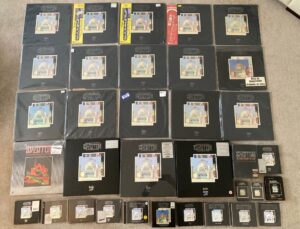
Marking the 50th anniversary today of the UK release of the Led Zeppelin double live album The Soundtrack to the Film The Song Remains The Same – as can be seen, it’s another Led Zeppelin release I cannot get enough of…


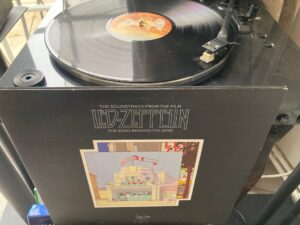
Saturday is platterday – on the player marking its 50th anniversary -Led Zeppelin double album The Soundtrack from the film The Song Remains The Same.
I already had a couple of 1973 US tour bootlegs but hearing this officially recorded set over three nights at Madison Square Garden in July 1973 was an absolute revelation.
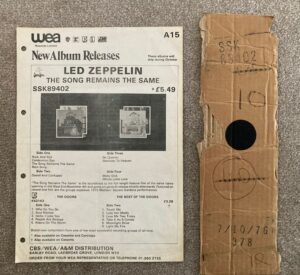
Working in the record department I had access to various things – including posters and display material.
As can be seen here the rep who called on our store gave me the record dealer information sheet and as I was the one who unpacked the boxes our order came in I retained part of the cardboard box -this has the Swan Song catalogue number and the date it went into the WEA warehouse 7/10/76 to be distributed to stores for the 22nd – now that’s what I call a unique piece of memorabilia!

Update here…
It’s a welcomed half term break for the good lady Janet this week before a busy November kicks in. As with a lot of people this time of year, we’ve been fending of colds which has slowed us down a bit.
Current DL Playlist:
Led Zeppelin – Led Zeppelin III – LP
Thunderclap Newman – Hollywood Dream -LP
Robert Plant – Saving Grace with Suzi Dian – LP
Badfinger – Magic Christian Music – LP
David Crosby – If I Could Only Remember My Name
Nick Drake – Five Leaves Left
Joni Mitchell – Blue
Until next time…
Dave Lewis – October 28 2026
TBL website updates written and compiled by Dave Lewis
Follow TBL/DL on Facebook:


Leave your response!